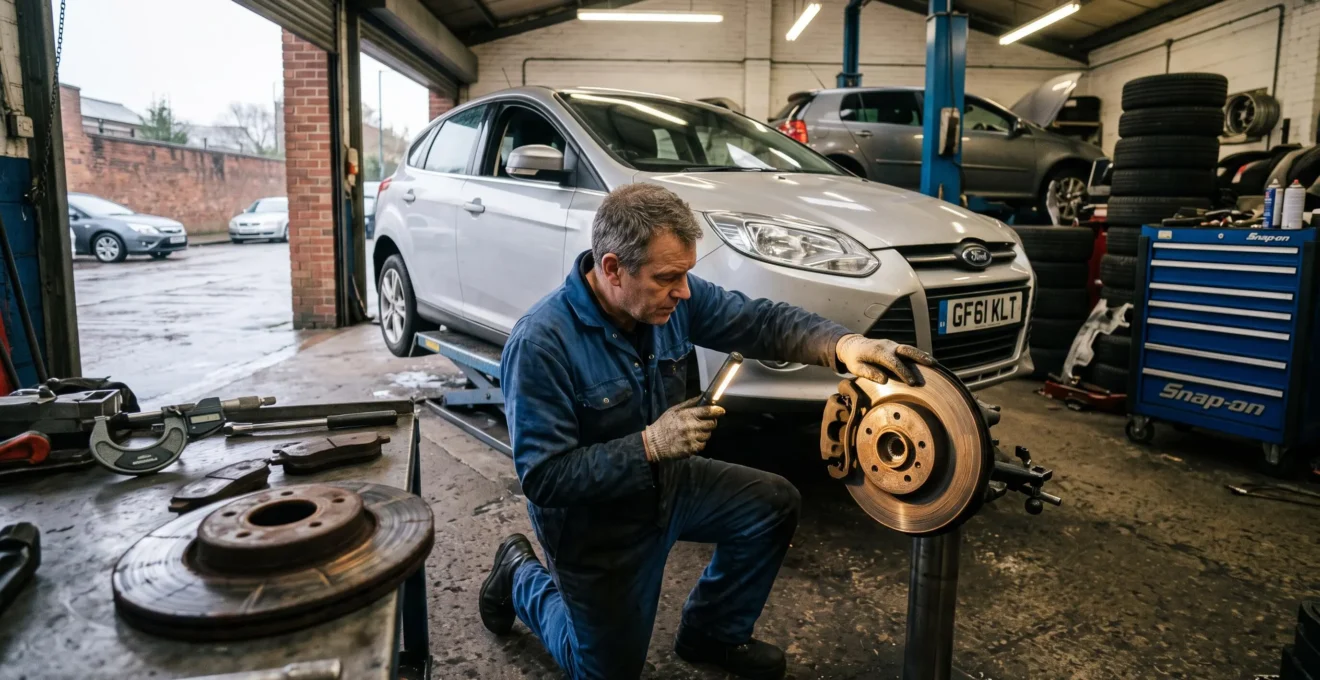
A change in stopping performance can signal worn brake pads, uneven brake discs, sticking calipers, deteriorated brake fluid or a fault in the hydraulic system. The first step is to identify what has changed: pedal travel, braking distance, vibration, noise, vehicle stability or the ability of the parking brake to hold the car.
These symptoms help prioritise an inspection, but they rarely identify a defective part on their own. A squeal might come from a wear indicator or harmless surface moisture. A vibration might originate in a brake disc, wheel or suspension component. A soft pedal, however, can indicate a hydraulic problem that requires immediate professional attention.
Drivers should distinguish accessible visual checks from measurements and repairs requiring workshop equipment. Brake discs have manufacturer-defined wear limits, friction pads need sufficient usable material, and calipers must operate freely without leakage. Replacement components must also match the vehicle’s exact brake specification.
If braking effectiveness has deteriorated, the pedal sinks, fluid is leaking or grinding is audible, stop driving as soon as it is safe and arrange professional assistance.
Brake inspection: the essentials
- Match the symptom to the likely component: vibration suggests checking discs and running gear; squealing suggests inspecting pads and hardware; abnormal pedal travel suggests a hydraulic fault.
- Inspect related components together. New pads cannot correct an excessively worn disc or a seized caliper.
- Select replacements using vehicle-specific specifications, measured wear and confirmed faults rather than mileage or noise alone.
- Why Do Brakes Vibrate During Moderate or Heavy Stopping?
- How to Spot Worn Brake Pads Through Visible and Audible Clues?
- Coated or Uncoated Brake Discs: Which Make Sense for Daily Driving?
- Cracked Brake Discs and Damaged Calipers: Warning Signs to Take Seriously
- When Does Brake Squealing Require Immediate Attention?
- How to Identify a Sticking Mechanical Handbrake Cable?
- Which Emergency Safety Items Should You Keep Within Reach in Your Car?
- Hydraulic or Mechanical Braking System: How Faults Affect Braking Response?
Why Do Brakes Vibrate During Moderate or Heavy Stopping?
Brake vibration during moderate or heavy stopping commonly points to variation in brake disc thickness, uneven friction deposits or disc runout, but suspension and steering faults can produce similar sensations. A pulsing brake pedal suggests a braking-system disturbance, while steering-wheel vibration often directs attention towards the front axle. Neither symptom identifies the faulty component conclusively.
Disc thickness variation means that different points around the braking surface have slightly different thicknesses. As the disc rotates between the pads, these differences can produce fluctuating braking torque and vibration. Uneven pad deposits and excessive lateral runout can contribute to the same problem.
According to HELLA technical information on brake discs, thickness differences of approximately 0.012–0.015 mm can cause brake judder on some vehicles. These figures describe potential vibration sensitivity, not universal disc replacement limits.
Heat-related surface changes may develop after repeated demanding stops, overheating or unsuitable pad bedding-in. Aggressive braking immediately after fitting new pads can interfere with the intended running-in process. Incorrect hub preparation, uneven wheel-bolt tightening and existing disc runout can also contribute to vibration.
When braking remains normal and no serious warning signs are present, the location of vibration can help a technician decide what to inspect:
- Brake pedal pulsation: check disc thickness variation, disc runout and the possibility of ABS intervention.
- Steering-wheel vibration during braking: prioritise front brake discs while also inspecting steering joints, wheel bearings and suspension components.
- Vibration felt through the seat or vehicle body: include the rear brakes and chassis components in the inspection.
- Vibration without braking: investigate wheel balance, tyres, wheels and running gear before attributing the problem to brake discs.
These observations should come from ordinary driving experience, not deliberate heavy-braking experiments on public roads. If the vehicle pulls unpredictably, braking becomes weak or vibration is severe, avoid further driving.
A workshop should measure disc thickness at multiple positions with an appropriate micrometer, check runout and inspect mounting surfaces. Simply replacing pads when discs are below their manufacturer-defined minimum thickness, excessively irregular or otherwise unserviceable leaves the underlying fault unresolved.
Once disc condition and running-gear faults have been considered, the next useful inspection is the friction material itself: brake pad wear can explain both abnormal noise and declining braking consistency.
How to Spot Worn Brake Pads Through Visible and Audible Clues?
Worn brake pads can be identified by reduced friction-material thickness, a persistent wear-indicator squeal, visible scoring or uneven wear between pads. Inspect the friction lining separately from its steel backing plate, because the total pad thickness is misleading. Both inner and outer pads must be assessed before deciding whether replacement alone is sufficient.
With the vehicle parked securely, the engine off and the brakes cool, a flashlight may reveal the outer brake pad through the wheel spokes. Look for the layer of friction material between the backing plate and the brake disc. A very thin layer warrants professional measurement rather than continued use based on appearance alone.
The inner pad may be difficult to see without removing the wheel or using suitable inspection equipment. Wheel removal should only be carried out with approved lifting and supporting equipment, never with a jack as the sole support.
1.5 mm
Under the UK MOT inspection criteria, brake lining or pad thickness below 1.5 mm is classified as a dangerous defect. This is a UK inspection threshold, not a universal safe replacement target; manufacturer requirements can call for earlier replacement.
Driver and Vehicle Standards Agency — DVSA MOT brake inspection criteria.
Many brake pads incorporate a small metal wear indicator designed to contact the disc as the lining approaches its wear limit. Its high-pitched squeal is a warning to arrange inspection, not a reason to keep driving until the sound becomes louder. Other vehicles use electronic wear sensors or dashboard alerts.
Uneven wear provides additional diagnostic information:
- An inner pad wearing substantially faster than its outer counterpart can indicate piston, slider or caliper movement problems.
- A tapered pad can indicate uneven pressure, binding hardware or misalignment.
- Marked differences between wheels on the same axle may suggest a caliper, hydraulic or mechanical imbalance.
Brake pad lifespan depends on vehicle mass, driving habits, traffic conditions, hills and towing loads. A vehicle used for frequent urban stops may experience different wear from one travelling mainly on open roads. For this reason, mileage alone is not a reliable replacement criterion.
When pads require replacement, check that the replacement set matches the specified axle, caliper design, friction requirements and sensor arrangement. Inspect discs and associated hardware at the same time, and replace pads in matched axle sets according to the vehicle manufacturer’s procedure.
If the discs also need replacement, corrosion protection becomes a separate purchasing consideration. It affects durability and appearance in exposed areas, rather than compensating for worn friction components.
Coated or Uncoated Brake Discs: Which Make Sense for Daily Driving?
Coated brake discs are generally worth considering for vehicles exposed to road salt, coastal moisture or frequent wet conditions because protective finishes help limit corrosion on non-friction areas. Uncoated discs can remain suitable where corrosion exposure and cosmetic appearance are less important. Neither option inherently shortens stopping distance when the discs otherwise meet the same vehicle specifications.
Brake disc coatings may cover the hub area, edges and ventilation vanes, or initially cover the entire disc. On fully coated designs, the finish on the friction track is removed through normal braking during the manufacturer’s prescribed running-in process. Protection generally remains on appropriate non-contact surfaces.
The exposed friction track can develop light surface rust when a vehicle is parked in damp weather, even with coated discs. Light corrosion may clear during normal braking; persistent pitting, severe corrosion or reduced braking effectiveness requires inspection.
For daily driving, the most relevant differences are:
| Selection criterion | Coated discs | Uncoated discs |
|---|---|---|
| Corrosion protection | Additional protection on coated non-friction surfaces | Exposed metal surfaces are more susceptible to visible corrosion |
| Appearance behind alloy wheels | Can preserve a cleaner appearance around the hub and edges | Surface rust may become more noticeable |
| Purchase cost | Often carries a price premium | May offer a lower initial component cost |
| Installation | Follow coating-specific preparation and bedding instructions | Follow the manufacturer’s cleaning and fitting requirements |
| Braking performance | Depends on the complete brake design and component specification | Depends on the same technical factors |
Factory-coated discs can reduce certain preparation tasks when supplied ready for installation, but installation time savings are not guaranteed. Some products still require specific handling, and neither coating type eliminates the need to clean the hub mounting face or verify correct fitting.
A city commuter in a relatively dry climate may reasonably prioritise price and correct specification. A coastal driver or someone using salted winter roads may place greater value on corrosion protection and appearance, especially with open alloy wheels.
Before ordering, verify the disc diameter, thickness, height, bolt pattern, ventilation design and required compatibility with the vehicle’s braking system. Check whether the selected disc is approved for the intended application and whether the manufacturer supplies additional installation instructions.
Whichever finish is selected, it cannot compensate for cracking, excessive wear or damaged calipers. Those conditions demand a separate safety assessment before any cosmetic or cost comparison.
Cracked Brake Discs and Damaged Calipers: Warning Signs to Take Seriously
Cracked brake discs, leaking calipers and seized braking components require prompt professional assessment because they can compromise structural integrity or braking balance. Fine superficial heat-check marks are not necessarily equivalent to deep structural cracks, but visible cracking should not be classified as harmless by appearance alone. A suspected structural crack or serious caliper defect warrants stopping vehicle use.
Heat checking can appear as shallow, fine surface lines produced by repeated thermal stress. More concerning indications include a distinct radial crack, a crack reaching the outer edge, an opening near a mounting area or signs that a crack extends into the disc body. These observations are reasons for professional inspection, not reliable at-home depth criteria.
Some performance-oriented brake disc designs have specific manufacturer inspection standards. On ordinary road vehicles, visible cracks should be assessed against the disc manufacturer’s guidance, and any suspected structural damage should be treated conservatively.
Calipers introduce another set of possible faults. A piston can become difficult to retract because of corrosion or seal problems, while seized slide pins may prevent the caliper from applying and releasing pressure evenly.
Warning signs include a burning smell near a wheel, persistent brake drag, pulling during braking, unusually rapid pad wear or unexplained deterioration in fuel economy. These symptoms are not specific to calipers: restricted hoses, parking brake faults and other components can produce similar effects.
A dragging brake generates unnecessary heat and can damage the affected disc, pads, seals and nearby components. The resulting braking imbalance may also make other wheels work harder, although the extent of secondary wear depends on the particular fault and how the vehicle is used.
During pad replacement, the technician should examine caliper piston movement, slide pins, seals, dust boots, brake hoses and signs of hydraulic leakage. A torn dust boot can allow contamination and corrosion to develop, making premature damage to newly fitted pads more likely.
Repair may involve servicing approved caliper components or replacing the caliper assembly, depending on the damage and manufacturer’s instructions. Both sides of the axle should be inspected, even when the initial defect appears confined to one wheel.
Noise can provide an earlier indication of similar problems, but not every squeal means that a disc or caliper is damaged. The type of sound, its persistence and any associated change in braking response determine urgency.
When Does Brake Squealing Require Immediate Attention?
Brake squealing requires immediate attention when it is persistent and accompanied by reduced braking effectiveness, abnormal pedal feel, pulling or severe vibration. Grinding or metal-on-metal scraping is especially concerning because it can indicate exhausted friction material. Brief squeaking after rain or overnight parking may be less serious, provided braking remains completely normal.
Moisture, light surface corrosion, pad vibration and bedding-in can all produce noise without indicating critical wear. However, a wear-indicator tab can generate a similar high-pitched squeal, so persistent sound should never be dismissed solely because the vehicle still stops.
The RAC advice on squeaky brakes and warning signs distinguishes temporary moisture-related noise from more concerning persistent squealing and metal-on-metal grinding.
The following symptom guide helps determine an appropriate response:
| Noise pattern | Possible explanation | Recommended response |
|---|---|---|
| Brief squeak after rain or overnight parking | Moisture or light surface rust | Monitor only if it disappears promptly and braking remains normal |
| Persistent high-pitched squeal | Pad wear indicator, glazing or hardware vibration | Arrange a prompt brake inspection |
| Squeal mainly under light braking | Pad vibration, glazing or fitting-related noise | Inspect pads, discs and hardware; do not assume pad wear alone |
| Noise continuing after new pad installation | Bedding-in or installation-related problems | Have the installation checked if persistent or accompanied by abnormal braking |
| Grinding or metal-on-metal scraping | Severe friction-material wear or component damage | Stop driving safely and arrange professional recovery or urgent repair |
| Noise with longer stopping distance or abnormal pedal feel | Potential braking-system fault | Stop driving safely and seek immediate assistance |
When pads retain adequate friction material, the cause may lie in missing or incorrectly fitted anti-squeal shims, damaged retaining clips or glazed friction surfaces. Correcting these faults can eliminate noise without replacing otherwise serviceable pads.
Noise after a recent brake replacement deserves particular attention. Incorrect hardware, contaminated surfaces, unsuitable friction material or failure to follow bedding-in instructions can contribute. A small amount of temporary bedding noise can be expected on some systems, but persistent squealing should not simply be accepted.
Brake noise cannot confirm component condition without inspection. A quiet braking system can still contain worn or damaged parts, while a noisy one may have adequate friction material.
Some noises that appear to originate from the rear service brakes actually come from parking brake components. Checking the handbrake mechanism prevents unnecessary hydraulic or disc-brake repairs.
How to Identify a Sticking Mechanical Handbrake Cable?
A sticking mechanical handbrake cable may cause the parking brake to release incompletely, leaving a rear wheel dragging and unusually warm after driving. Excessive lever travel or more clicks than normal can also suggest adjustment or wear problems, but these symptoms do not prove that the cable is seized. The rear brake mechanism must be inspected as well.
A mechanical parking brake typically uses a lever or pedal to pull cables that operate rear drum brakes or a parking brake mechanism integrated into the rear calipers. Corrosion inside a cable sheath can restrict movement, while cable stretch, excessive clearance or worn components can affect holding performance.
A simple observation begins with the vehicle stationary on level ground and secured against movement. Note whether the parking brake lever returns normally, whether the warning indicator behaves as expected and whether resistance or travel has changed. Do not rely on the parking brake alone to secure a vehicle with a suspected fault.
After driving, a persistent burning smell or unusually hot rear wheel may indicate brake drag. Do not touch the wheel, disc or caliper to test its temperature; hot brake components can cause burns.
To distinguish a seized cable from a stretched or maladjusted system, a technician can inspect cable movement and the return action of the rear brake operating lever:
- Cable does not return freely: corrosion, mechanical binding or damaged routing may require cable replacement.
- Cable moves freely but lever travel is excessive: adjustment, cable stretch or wear within the brake mechanism may be responsible.
- Cable releases but the brake remains applied: the caliper’s integrated parking brake mechanism or drum hardware may be seized.
Adjustment should follow the manufacturer’s procedure and only after confirming that the brakes release correctly. Tightening an adjustment to compensate for a seized mechanism can worsen drag and overheating.
Electronic parking brakes require different checks. Some use motor-driven caliper mechanisms, while others use electrically actuated cable systems. Diagnostic equipment and a manufacturer-defined service mode may be necessary before repair.
A sticking parking brake can mimic service-brake drag through heat, friction and increased fuel consumption. Identifying which mechanism is holding the wheel avoids replacing otherwise functional hydraulic components.
When a dragging brake or another fault makes roadside driving unsafe, preparation matters as much as diagnosis. Accessible emergency equipment helps reduce exposure to traffic while assistance is arranged.
Which Emergency Safety Items Should You Keep Within Reach in Your Car?
A brake-related emergency kit should contain a high-visibility vest, an approved warning triangle where appropriate, a working torch and a charged phone. These items help drivers make themselves visible and contact assistance after stopping safely. Basic tools and vehicle documentation can also be useful, but roadside brake repairs should not be attempted in an unsafe location.
The most important action after sudden braking deterioration is to control the vehicle, avoid abrupt manoeuvres where possible and reach a safe stopping place. Activate the hazard warning lights and follow local road-safety guidance. On a motorway or high-speed road, remain away from moving traffic and use a protected waiting area when available.
A practical emergency kit includes:
- High-visibility vest: keep it within reach of the driver so it can be worn before exiting where safe and appropriate.
- Reflective warning triangle: carry one where required or useful, but do not enter a live traffic lane or place it where doing so would expose anyone to danger.
- Working torch: useful for visibility and checking surroundings without approaching hot or moving components.
- Gloves and wheel brace: useful for permitted wheel-related roadside tasks, but not for improvising brake repairs.
- Tyre inflator or manufacturer-approved sealant: useful for certain tyre problems, not as a remedy for brake failure.
- Vehicle handbook and assistance details: provide component specifications, dashboard-warning information and recovery contacts.
Legal requirements differ between countries and sometimes between vehicle categories. Rules concerning warning triangles and high-visibility clothing in the United Kingdom, United States, Canada, Australia and European countries should be checked individually, particularly before cross-border travel. No single equipment list establishes legal compliance everywhere.
Keep essential visibility and communication equipment inside the cabin when practical and securely stowed so it cannot become a projectile. Larger tools may be stored in the boot, provided they are restrained and accessible. A heavily loaded boot can delay access during a roadside incident.
None of these items makes continued driving with defective brakes safe. A wheel brace cannot correct hydraulic pressure loss, and inspecting an exposed wheel on a busy road may create more danger than the original breakdown.
Roadside preparation addresses what happens after a fault develops. Understanding the hydraulic and mechanical parts of the braking system helps determine why the vehicle’s response changed in the first place.
Key takeaways before the final system check
- A change in pedal feel deserves a different investigation from disc-related vibration or parking brake drag.
- Heat, fluid leakage and abnormal brake release can reveal faults extending beyond pads and discs.
- Replacement should follow diagnosis of the complete braking circuit, with vehicle-specific specifications taking precedence over generic thresholds.
Hydraulic or Mechanical Braking System: How Faults Affect Braking Response?
Hydraulic faults generally affect pressure transmission and pedal response, while mechanical faults often cause restricted movement, uneven braking or failure to release fully. A soft or sinking pedal can indicate air, leakage or master-cylinder problems; pulling and dragging may indicate seized calipers or linkages. Because symptoms overlap, reliable diagnosis requires inspection of both systems.
In most modern passenger cars, the service brakes use hydraulic pressure from the master cylinder to operate wheel brakes. Mechanical elements still play an essential role through pad movement, caliper hardware and, on some vehicles, cable-operated parking brakes.
Hydraulic warning signs include a soft pedal, excessive travel, a pedal that gradually sinks under steady pressure or visible fluid leakage. These symptoms can indicate a serious fault even if the dashboard does not display a warning. A pedal that sinks unexpectedly, especially with reduced braking response, calls for immediate professional attention.
Brake fluid is particularly important. Common glycol-based DOT 3, DOT 4 and DOT 5.1 fluids absorb moisture over time. Excess moisture reduces boiling point and can allow vapour formation under high braking temperatures, compromising hydraulic pressure transmission.
The HELLA brake fluid testing and maintenance guidance explains why moisture content or boiling point should be assessed with suitable test equipment. Fluid colour alone is not a reliable condition test. Fluid type and replacement intervals must follow the vehicle manufacturer’s instructions; general maintenance guidance cannot override those specifications.
Brake fluid level also requires context. It may gradually decrease as brake pads wear and pistons extend, but a sudden or unexplained drop can indicate leakage. Do not simply top up repeatedly without investigating the cause, and never substitute an unapproved fluid specification.
Modern ABS and electronic stability systems can change braking behaviour during intervention and record faults electronically. They do not guarantee that an underlying hydraulic or mechanical defect will be compensated for. Warning lamps, pedal feel and physical component condition all remain important.
Five checks to organise a brake-system diagnosis
- Record the symptom: note whether the change involves pedal travel, noise, vibration, pulling or braking distance, and produce a short symptom description for the workshop.
- Check stationary indicators: with the vehicle safely parked, observe the brake warning lights and any visible fluid-level warning; record displayed messages without dismantling hydraulic components.
- Review maintenance information: locate the last brake fluid service and the manufacturer-specified fluid type; prepare a dated maintenance record or note that the history is unknown.
- Request a component inspection: have a technician check hoses, calipers, parking brake operation, pad thickness and disc measurements; obtain the findings and measured wear values.
- Confirm replacement suitability: match proposed pads, discs, calipers or fluid to the exact vehicle specification and request confirmation that the original fault has been corrected before returning the vehicle to service.
Inspection priority depends on severity rather than component price. A possible hydraulic failure must be addressed before routine pad wear, while vibration with otherwise normal braking may call for disc and running-gear measurements. Diagnosis should proceed from the most safety-critical symptom to the relevant physical and electronic checks.
If stopping performance has changed, document the symptoms and arrange a qualified brake inspection before purchasing replacements. Ask for measured wear, an explanation of the fault and parts matched to the vehicle’s specification. Where braking is unreliable, stop using the vehicle and arrange recovery rather than driving to the workshop.
Should brake pads and discs always be replaced together?
Not necessarily. Serviceable discs may be retained if they meet the manufacturer’s thickness, surface-condition and runout requirements and are suitable for the replacement pads. Discs that are excessively worn, damaged or otherwise outside specification require replacement. Brake pads and discs are normally replaced in matched axle sets where specified, rather than changing one side without addressing the other.
Can a car pass a roadworthiness inspection and still need brake maintenance?
Yes. Roadworthiness inspections apply defined criteria at the time of testing and do not guarantee the remaining service life of components. Manufacturer replacement limits and the vehicle’s operating condition may justify maintenance before a legal inspection failure occurs. Inspection standards also vary by country.
Is it safe to drive when the brake pedal feels softer than usual?
An unexplained soft pedal should be treated as a potentially serious hydraulic fault. Air in the lines, leakage or other pressure-transmission problems may be responsible. If the pedal sinks, braking weakens or the change is sudden, stop safely and arrange recovery or professional assistance rather than continuing to drive.
How can the correct replacement brake parts be identified?
Use the vehicle’s identification details, model variant, production information and actual fitted brake specification. Different versions of the same model may use different disc diameters, calipers, pad shapes or wear sensors. Confirm compatibility against reliable parts catalogues and manufacturer specifications before installation.
Can ABS or stability-control warning lights identify a worn brake disc?
Not reliably. ABS and stability-control warnings usually indicate faults detected within monitored electronic or hydraulic systems, rather than directly measuring ordinary disc friction-surface wear. A diagnostic scan can help identify recorded system faults, but physical inspection and measurement are still necessary to establish disc and pad condition.