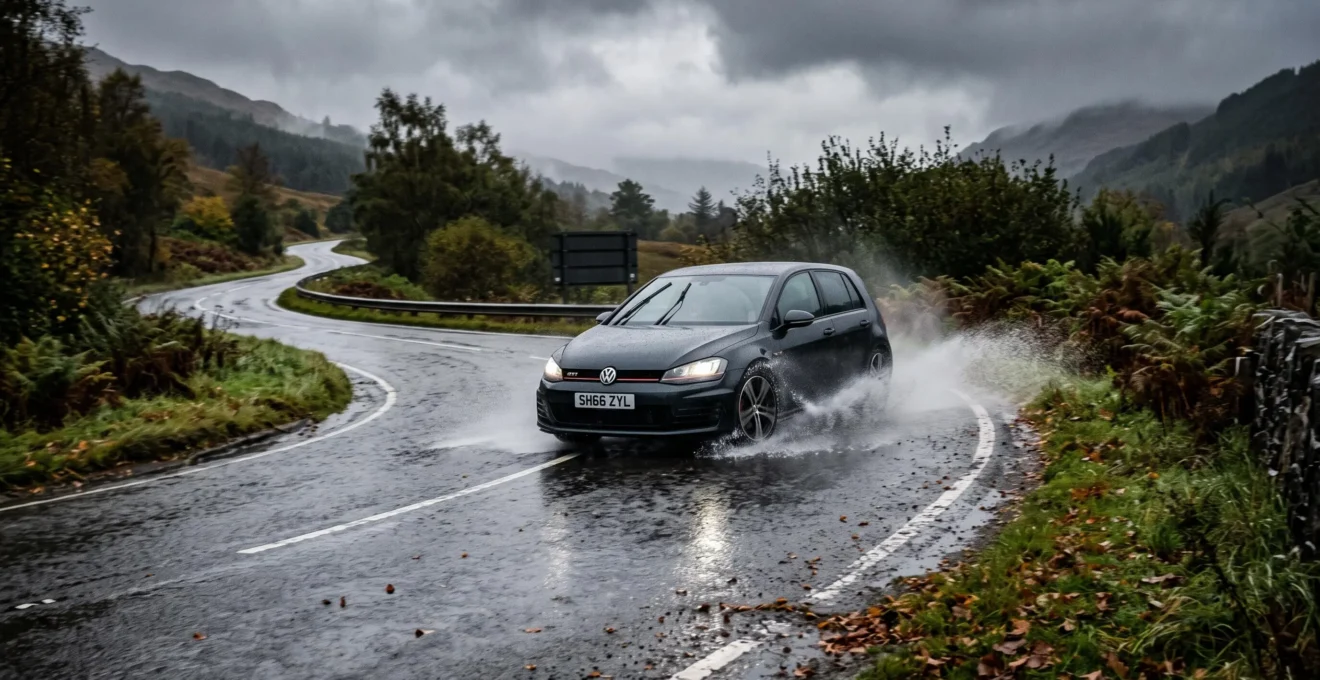
A car that feels secure on a dry, straight road can become noticeably less predictable when turning into a wet junction, negotiating a roundabout or crossing a patch of standing water. The difference comes down to road holding: the ability of the tyres to maintain sufficient contact and friction with the road while the vehicle accelerates, brakes or changes direction.
Road holding depends on more than tyre tread alone. Inflation pressure, rubber condition, wheel alignment, suspension damping and the distribution of forces between the wheels all influence how much grip remains available. Road conditions then determine how quickly that available grip can be exhausted.
Loss of grip rarely announces itself through one unmistakable symptom. Steering may become less precise, a car may run wider through a bend, or its rear end may feel unsettled over uneven surfaces. Understanding these changes makes it easier to distinguish a maintenance issue from an unsuitable driving speed and take action before an emergency manoeuvre exposes the problem.
What matters most for reliable road holding
- Tyre condition determines available grip: worn tread, ageing rubber and uneven wear can reduce the margin for braking and cornering, particularly on wet surfaces.
- Vehicle condition affects how grip is delivered: incorrect tyre pressure, poor alignment and worn dampers can make handling less consistent.
- Driving technique protects the remaining margin: reduce speed before bends, allow more stopping distance in poor weather and avoid sudden steering or braking inputs.
- Why Does a Car Lose Grip More Easily on Worn Wet-Road Tyres?
- How to Read Tyre Wear Patterns That Suggest Handling Problems?
- Front-Wheel Drive or Rear-Wheel Drive: How Does Grip Behaviour Differ?
- How Incorrect Tyre Pressure Can Reduce Cornering Grip
- When Should You Slow Down Before Entering a Bend?
- When Should You Adjust Your Driving Routine for Rain, Frost or Fog?
- Why Does Your Car Bounce Repeatedly After Driving Over a Bump?
- How to Improve Driving Safety Through Vehicle Checks and Better Habits
Why Does a Car Lose Grip More Easily on Worn Wet-Road Tyres?
Worn tyres lose wet-road grip more easily because their shallower tread grooves cannot evacuate water as effectively from beneath the contact patch. As speed or water depth increases, the tyre may lose direct contact with the asphalt, reducing steering and braking control. Tyre age, rubber condition and differences in wear between wheels can further affect handling.
On a dry surface, tyre rubber interacts directly with the road’s texture. In rain, tread grooves must channel water away quickly enough to preserve that contact. As tread depth decreases, the tyre has less capacity to accommodate and disperse water. If water builds up beneath it, the tyre can begin to ride on a film rather than the road itself. This is aquaplaning, and it can cause a marked reduction in steering and braking effectiveness.
The risk depends on several interacting factors, including vehicle speed, water depth, tread condition and inflation pressure. A tyre does not need to be completely bald before its wet-road performance becomes a concern. Equally, no single tread-depth figure guarantees freedom from aquaplaning.
Rubber condition also matters. Tyres age through exposure to environmental conditions and use, even when their tread appears adequate. Ageing can change rubber properties, although the effect on wet grip varies with tyre construction, compound and operating history.
The NHTSA tyre safety and maintenance guidance explains how to identify a tyre’s manufacturing date using the final four digits of its DOT identification number, which indicate the production week and year. It also warns that tyre ageing cannot reliably be identified by appearance alone. Surface cracking, bulges or other visible deterioration warrant professional inspection, but their absence does not establish that an older tyre is safe.
Grip deterioration may develop gradually enough to escape everyday attention. A driver who rarely brakes hard or corners near the available friction limit might notice little difference until the vehicle encounters standing water or needs to stop suddenly. This makes scheduled inspection more reliable than waiting for handling to feel noticeably worse.
Differences between tyres add another complication. If the left and right tyres on an axle have substantially different tread conditions, they may deliver unequal grip during braking or turning, especially on a surface with uneven water coverage. The vehicle can then respond less symmetrically to steering and braking inputs. Replacement tyres should therefore be chosen and fitted in accordance with the vehicle and tyre manufacturers’ recommendations.
Tread depth, age and visible damage should be considered together. The next step is to examine how a tyre is wearing, because its wear pattern may reveal a mechanical problem that is also affecting road holding.
How to Read Tyre Wear Patterns That Suggest Handling Problems?
Tyre wear patterns provide clues about inflation, wheel alignment and suspension condition. Wear across both shoulders often suggests under-inflation, while excessive centre wear can indicate over-inflation. One-sided, feathered or cupped wear may point towards alignment or suspension problems. These patterns are diagnostic indicators, not proof of a particular fault, and persistent irregular wear requires investigation.
A tyre should generally wear in a reasonably consistent manner across its tread when correctly inflated and used under suitable conditions. Differences between the centre, shoulders and individual tread blocks can indicate that loads are not being distributed as intended.
The following comparison helps turn a routine visual inspection into a useful preliminary assessment.
| Visible wear pattern | Possible cause | Recommended next step |
|---|---|---|
| Both shoulders worn more than the centre | Under-inflation or operating conditions that increase shoulder loading | Check cold pressure against the vehicle’s recommended setting. |
| Centre worn more than the shoulders | Possible over-inflation | Verify pressure and inspect the remaining tread. |
| One edge substantially more worn | Wheel alignment, camber or suspension geometry problems | Request a professional alignment and suspension inspection. |
| Feathering across tread blocks | Abnormal tyre scrubbing, often associated with alignment | Have wheel alignment and steering components checked. |
| Cupping or repeated high and low spots | Possible damper wear, suspension faults or wheel imbalance | Arrange suspension, damper and wheel checks. |
Irregular wear can become self-reinforcing. When a tyre develops substantial differences in tread height or shape, its interaction with the road becomes less consistent. The underlying mechanical fault may continue to produce the same wear pattern, while the increasingly uneven tyre can introduce further vibration or handling irregularity. Simply inflating it correctly will not reverse damage already present.
To inspect tread depth, park safely on level ground and examine the inner, central and outer tread areas separately. A suitable tread-depth gauge provides a more precise measurement than a coin. A recognised local coin test can be a preliminary indication, but coin dimensions differ between countries and the test does not replace measurement against the applicable legal requirements.
In the United States, NHTSA describes a penny test associated with its 2/32–inch tread replacement threshold. That threshold and method must not be assumed to apply in the United Kingdom, Australia, Canada or every other English-speaking jurisdiction.
Feathering may be detected by carefully moving a hand across undamaged tread blocks: the surface can feel relatively smooth in one direction and sharper in the other. Do not perform this check if exposed cords, embedded sharp objects or significant tyre damage are suspected.
Inner-edge wear deserves particular attention because it can remain hidden during a casual walk-around. On a safely parked vehicle, turning the front wheels towards full steering lock may expose the inner shoulders for inspection. Never place a hand near a wheel while it is moving.
As explained in TyreSafe‘s wheel alignment inspection advice, wear patterns can suggest possible causes, but proper wheel alignment requires specialist measuring equipment. Worn steering or suspension components should also be addressed before alignment adjustments are made.
Identifying abnormal wear is only part of understanding handling. The way drive forces are distributed between the front and rear tyres also influences which end of the vehicle is most likely to lose grip first.
Front-Wheel Drive or Rear-Wheel Drive: How Does Grip Behaviour Differ?
Front-wheel-drive cars commonly tend towards understeer when the front tyres run out of available cornering grip, while rear-wheel-drive cars can develop power-induced oversteer when acceleration overwhelms rear-tyre traction. Neither behaviour is inevitable: speed, tyre condition, vehicle design, road friction and electronic stability systems can substantially change how either drivetrain responds.
Every tyre has a limited capacity to transmit forces to the road. When a tyre must accelerate and steer simultaneously, these demands share its available grip. Braking and cornering forces likewise compete for the same limited traction.
In a front-wheel-drive vehicle, the front tyres provide both steering and propulsion. They also generally handle a substantial share of braking forces because of forward load transfer during deceleration. Applying excessive acceleration while turning can therefore exceed the front tyres’ combined grip capacity.
The characteristic result is understeer: the vehicle follows a wider path than intended despite the steering wheel being turned towards the bend. The appropriate response is to ease off excessive acceleration and reduce steering demand smoothly rather than turning the wheel increasingly sharply. Avoid abrupt inputs that could destabilise the vehicle.
In rear-wheel-drive vehicles, the rear tyres provide propulsion. Excessive driving torque on a low-grip surface can cause the rear tyres to slide sideways. This is oversteer, often experienced as the rear of the vehicle stepping outward relative to the intended direction.
A driver should look towards the intended path, avoid sudden braking or steering changes and make smooth, appropriate steering corrections while reducing excessive acceleration. The precise correction depends on the vehicle, speed, surface and direction of the slide. Electronic stability control may assist, but no simple technique can guarantee recovery once traction is substantially lost.
| Handling characteristic | Front-wheel drive | Rear-wheel drive |
|---|---|---|
| Driving force | Front tyres | Rear tyres |
| Common power-related grip limit | Front-end understeer | Rear-end oversteer |
| Possible warning sensation | Car runs wider than the steering input suggests | Rear of the car begins moving sideways |
| Important maintenance focus | Front tyre condition and steering response | Rear tyre condition and stability under acceleration |
Powerful front-wheel-drive cars may also experience torque steer, where unequal driving forces influence steering feel under acceleration. Repeated demanding bends can build tyre temperature and increase wear. However, the amount of grip change depends on tyre design, temperature and driving conditions; front-wheel-drive tyres do not necessarily overheat during ordinary driving.
All-wheel drive distributes driving force across more wheels and can improve acceleration traction, but it does not inherently improve braking friction or eliminate cornering limits. An AWD vehicle still depends on its tyres for stopping and turning. Uneven tyre dimensions or wear can also create mechanical or handling concerns, particularly where manufacturers specify tight tyre-matching requirements.
Regardless of which wheels receive engine power, their ability to respond predictably depends on correct tyre inflation. Pressure changes the way the tread and sidewall carry forces through a corner.
How Incorrect Tyre Pressure Can Reduce Cornering Grip
Incorrect tyre pressure can reduce cornering grip by changing how a tyre deforms and transmits forces to the road. Under-inflation increases sidewall flexing and can make steering less precise, while over-inflation can reduce effective road contact and make responses less forgiving. The correct setting is the vehicle manufacturer’s recommendation for its tyres and load, not the highest available pressure.
A tyre’s contact patch changes shape under load, acceleration, braking and steering. Inflation pressure helps determine how the tyre structure supports that load. Too little pressure allows excessive deformation, while too much can alter contact pressure distribution and concentrate wear towards the centre of the tread.
Under-inflated tyres can flex excessively through bends, generating heat and increasing wear on the tread shoulders. Steering response may feel delayed or less defined because the tyre deforms more before generating the intended cornering force.
Over-inflation may reduce the effective contact area and produce a firmer, less compliant response on uneven surfaces. Neither sensation is a reliable pressure measurement: tyre construction, suspension settings and road texture can create similar symptoms.
According to TyreSafe’s tyre pressure advice, both under-inflation and over-inflation can compromise handling and contribute to abnormal tread wear. The relevant reference is the pressure specified by the vehicle manufacturer.
The correct pressure is usually listed on a vehicle information label near the driver’s door or fuel filler flap, or in the owner’s manual. Some manufacturers specify different values for normal loading, a fully loaded vehicle, towing or particular driving conditions. Use the setting that matches the vehicle’s actual operating requirements.
Pressure should be checked with cold tyres. NHTSA describes a cold measurement as one taken after the vehicle has remained undriven for at least three hours. Driving heats the tyres and can raise the measured pressure. Releasing air to match a cold-pressure specification immediately after a journey can therefore leave the tyres under-inflated once they cool.
Check with a reliable gauge rather than relying on the dashboard tyre pressure monitoring system. TPMS is designed to warn about significant pressure problems, not to replace routine maintenance. Some systems infer pressure changes indirectly from wheel behaviour, while others measure pressure through wheel-mounted sensors; their detection capabilities differ.
A gradual leak or a relatively small pressure imbalance may affect tyre condition before a warning becomes apparent. If pressure repeatedly falls, investigate the cause rather than repeatedly topping it up without inspection.
Properly inflated tyres provide a more predictable foundation for handling, but they cannot compensate for excessive speed. Before entering a bend, the driver must still judge whether enough grip is available for the intended path.
When Should You Slow Down Before Entering a Bend?
Slow down before entering a bend whenever the exit is not clearly visible, the surface may be slippery, or the vehicle cannot safely negotiate the curve at its current speed. Complete substantial braking while travelling straight whenever practical, then steer smoothly through the corner. The appropriate entry speed must account for the least favourable surface likely to be encountered throughout the bend.
Cornering requires lateral tyre force to change the vehicle’s direction. As speed increases, the force needed to follow the same radius rises rapidly. Wet asphalt, loose debris, frost or worn tyres may reduce available friction at the same time that the bend demands it.
Braking introduces an additional demand. Deceleration transfers load towards the front axle and away from the rear, altering how much force each tyre can generate. Heavy or abrupt braking while turning can exceed the combined braking and cornering capacity of one or more tyres.
This does not mean all braking during a corner is automatically unsafe. Gentle braking may be appropriate in some circumstances, and modern braking systems can help preserve control. However, finishing substantial speed reduction before turn-in generally leaves more of the tyres’ available grip for steering and makes vehicle behaviour easier to manage.
Before entering a bend, assess the following conditions together rather than treating the posted speed limit as the correct target speed.
| Condition | What to look for | Driving implication |
|---|---|---|
| Available visibility | Hidden exit, blind crest, obstructing vegetation | Choose a speed that allows stopping within the clear road ahead. |
| Surface grip | Damp patches, standing water, leaves, gravel | Reduce entry speed and avoid abrupt inputs. |
| Road geometry | Tightening curve, adverse camber, downhill gradient | Allow for additional cornering or braking demands. |
| Tyre and suspension condition | Wear, incorrect pressures, unstable responses | Increase the safety margin and address defects. |
| Changing conditions | Shaded areas, repaired surfaces, painted markings | Anticipate changes in grip beyond the visible entry. |
The exit of a bend can be more demanding than its entry. A road may begin on clean, relatively dry asphalt and then pass through standing water, damp leaves or frost beneath trees. Painted road markings and some repaired surfaces may also provide different grip levels, particularly when wet.
Because the vehicle must maintain its path across the entire bend, the safe approach should reflect the most challenging foreseeable section, not merely the road surface at the entry.
Anti-lock braking systems and electronic stability control can help manage wheel slip and vehicle instability within physical limits. They cannot manufacture friction where little exists. Their presence should not justify a higher entry speed or shorter following distance.
When grip unexpectedly changes mid-corner, look towards the intended path, ease off excessive accelerator input and avoid sudden steering or braking movements. If braking becomes necessary, apply it as smoothly as conditions allow while prioritising the avoidance of hazards.
Road geometry is only one source of uncertainty. Weather can change the available friction and visibility within a few metres, making the timing of driving adjustments equally important.
When Should You Adjust Your Driving Routine for Rain, Frost or Fog?
Adjust your driving routine as soon as rain, frost or fog changes either road grip or visibility, rather than waiting until the vehicle feels unstable. Rain increases the risk of water-related traction loss, frost can create nearly invisible ice, and fog reduces the distance in which hazards can be identified. Each condition requires a different response, particularly during rapid weather transitions.
Rain introduces water between the tread and road surface. Depending on water depth, tread condition and speed, this can reduce friction or lead to aquaplaning. Standing water in wheel ruts, near drains or on poorly drained sections is particularly important to anticipate.
Increase the distance to the vehicle ahead and reduce speed early. The UK’s Highway Code advises allowing at least double the normal stopping distance in wet weather compared with dry conditions. This is general safety guidance rather than a guarantee of a particular braking distance for every vehicle.
When steering suddenly feels unusually light or unresponsive while crossing standing water, aquaplaning may be occurring. Ease off the accelerator, maintain a smooth steering input and allow the vehicle to slow progressively. Abrupt braking or sharp steering may make recovery more difficult.
Frost creates a different problem. Bridges, exposed sections and shaded roads may freeze while surrounding roads appear clear. A surface that looks merely damp can contain black ice, leaving very little usable grip.
On potentially icy roads, reduce speed much further, leave substantially more stopping distance and avoid abrupt manoeuvres. Do not rely on the appearance of the main road to judge every bridge or shaded bend along the route.
Up to 10 times
The UK’s Highway Code warns that stopping distances on icy or snowy roads can be ten times greater than on dry roads. This is a general warning for icy or snowy conditions, not a fixed multiplier for every frost-covered surface.
UK Department for Transport, The Highway Code, rule 230.
Fog primarily affects visibility rather than the tyre-road friction itself. The main danger is travelling too quickly to identify an obstruction and stop safely. Reduce speed to remain able to stop well within the distance that can be seen clearly, use appropriate vehicle lighting and follow the rules applicable in the country where driving.
Weather transitions can be especially deceptive. Rain after a dry spell may combine with accumulated surface contaminants, creating unexpectedly slippery areas. A morning thaw can leave some sections wet while others remain frozen. Fog may disappear temporarily and then return suddenly.
For these situations, the Highway Code’s adverse-weather driving rules provide official UK guidance on increased stopping distances, smooth control inputs, changing road conditions and visibility. Legal lighting requirements and numerical thresholds must be checked against local rules outside the UK.
Seasonal maintenance is part of this adjustment. Falling temperatures can change tyre pressures, and insufficient tread becomes particularly concerning when roads are frequently wet. Inspect tyre condition before the wet or cold season rather than waiting for the first severe weather event.
Even with suitable tyres and careful driving, road holding can deteriorate if the suspension fails to control wheel movement over bumps. Repeated bouncing is one warning sign that deserves investigation.
Why Does Your Car Bounce Repeatedly After Driving Over a Bump?
A car that continues bouncing after a bump may have worn or ineffective suspension dampers, commonly called shock absorbers. Springs compress and release to absorb road disturbances, while dampers control the resulting movement. When damping is insufficient, the body or wheels can oscillate repeatedly, reducing ride stability and potentially compromising tyre contact with uneven road surfaces.
The suspension must perform two related functions: absorb disturbances without transferring every impact directly to the occupants, and keep the tyres following the road as consistently as possible.
A spring stores energy when compressed and releases it as it returns towards its original position. A damper dissipates movement energy and limits repeated oscillation. If the damper deteriorates, the spring may continue moving the vehicle body after the initial bump has passed.
Repeated body movement can make the vehicle feel as though it floats, pitches or takes too long to settle. On uneven roads, poor wheel control can also create larger variations in tyre loading and, in severe cases, intermittent loss of effective road contact.
These effects become particularly important during braking or cornering, when consistent tyre contact and predictable load distribution are needed. Worn damping may contribute to reduced stability, longer stopping distances under certain conditions and irregular tyre wear, although the severity depends on the vehicle, surface and specific fault.
A preliminary check sometimes used by drivers is the stationary corner bounce test. With the vehicle safely parked on level ground, press down firmly on a suitable structural area above one wheel, if the vehicle design permits, and release. Observe how the body settles without placing hands near moving suspension components.
Repeated uncontrolled oscillations may suggest inadequate damping. However, the bounce test is not a definitive diagnostic procedure. Modern suspension designs, vehicle weight, spring characteristics and damper technology can make the result difficult to interpret. A vehicle can also have defective dampers without displaying obvious excessive movement during a stationary test.
More useful evidence comes from combining symptoms. Look for persistent bouncing after bumps, increased body movement during braking, unusual instability in bends, abnormal tyre cupping or visible fluid leakage around a damper. A light surface film is not necessarily evidence of failure, and some faults produce no visible leaks.
Persistent suspension problems can affect other components. Excessive movement and vibration may contribute to irregular tyre wear and place additional loads on bushes, joints and related parts. The exact damage depends on the mechanical condition, so a complete suspension inspection is preferable to replacing components based only on a bounce symptom.
If the vehicle repeatedly loses composure over ordinary road irregularities, has pronounced vibration or feels unstable while turning or braking, avoid demanding driving and arrange a professional assessment. Severe instability or suspected loss of wheel control requires stopping safely and obtaining assistance rather than continuing the journey.
Tyres, pressure, alignment and damping work together. A practical maintenance routine should assess these interacting factors rather than treating each symptom as an isolated concern.
Key takeaways before your next journey
- Respond to changes, not just breakdowns: new vibrations, unusual steering or uneven wear justify inspection before the symptoms become severe.
- Separate observation from diagnosis: drivers can identify warning signs, but alignment and suspension faults often require professional equipment.
- Protect the handling margin: regular maintenance and earlier speed adjustments give the vehicle more capacity to cope with unexpected road conditions.
How to Improve Driving Safety Through Vehicle Checks and Better Habits
Driving safety improves when regular vehicle checks are combined with smooth, conditions-aware driving habits. Inspect tyre pressure, tread wear and visible suspension condition at least monthly, pay attention to unusual handling and adjust speed before challenging manoeuvres. Drivers can identify many warning signs themselves, but persistent steering, alignment or suspension problems require professional diagnosis.
A practical routine starts before the journey. Check that tyres show no obvious damage or severe deflation, dashboard warning lights behave normally and there are no new symptoms suggesting unsafe handling. When planning a longer trip or travelling in difficult weather, allow additional time for tyre inspection.
At least monthly, measure cold tyre pressures and check tread condition across each tyre, including areas that are not readily visible. Compare the left and right sides of each axle and investigate substantial differences. Record any repeated pressure loss, cracks, bulges or unusual wear patterns.
Inspect visible suspension components without crawling beneath an unsupported vehicle. Notice significant fluid leakage, unusual ride height or changes in how the body settles after bumps. These are reasons to request an inspection rather than attempt unqualified repairs.
The following checklist creates a simple record that can support a workshop diagnosis if a problem persists.
Five checks to document your car’s handling condition
- Measure all tyre pressures cold. Compare each reading with the manufacturer-approved setting for the vehicle’s load and record the measured and recommended values.
- Inspect tread across every tyre. Check inner, centre and outer tread areas, using a suitable tread-depth gauge where possible. Record the lowest measurement and any visible damage.
- Compare wear patterns across each axle. Note shoulder wear, centre wear, one-sided wear, feathering or cupping. Keep a written description or dated photograph of any abnormality.
- Check for suspension warning signs. Record persistent bouncing, unusual noises, visible leakage or instability after bumps, including when and where the symptom occurs.
- Review driving conditions and arrange necessary repairs. Confirm that tyre and pressure concerns have been addressed, and document any professional inspection needed for alignment, steering or dampers.
Driver-level checks should stop at the boundary of safe observation and straightforward maintenance. Tyre pressure and visible tread condition can be assessed with basic equipment. Wheel alignment, suspension geometry, damper effectiveness and steering-joint condition require appropriate diagnostic expertise.
If a tyre shows exposed cords, a bulge, severe structural damage or suspected failure, do not continue driving on it. Similarly, significant steering instability, persistent brake-related pulling or signs of serious suspension damage call for professional assistance before further use.
Maintenance is most effective when paired with habits that avoid unnecessarily consuming available grip. Adjust speed to the road surface and visibility rather than assuming the posted limit is always suitable. Allow greater following distance in rain or fog, reduce speed before bends and maintain smooth accelerator, brake and steering inputs.
These actions reinforce one another. Correct inflation helps preserve more consistent tread wear. Even tread and appropriate tyre condition contribute to predictable traction. Healthy suspension damping helps the tyres maintain effective contact over uneven surfaces. Smooth driving then reduces the likelihood of demanding more friction than the road can provide.
None of these measures guarantees grip on every surface. Their value is in maintaining a larger, more predictable safety margin and identifying problems before normal driving conditions become difficult to manage.
Before your next journey, check your tyre pressures and visible tread condition, then address any unusual handling symptoms rather than waiting for them to worsen. If the vehicle still feels unstable with correctly inflated, serviceable tyres, arrange a qualified inspection of its alignment, steering and suspension before relying on it in demanding conditions.
Can a car lose grip even when its tyres have legal tread depth?
Yes. Legal tread depth is not a guarantee of grip in all conditions. Tyre age, rubber condition, inflation pressure, tread design, road contamination and water depth all influence traction. A tyre may comply with the applicable tread-depth requirement yet still perform poorly on a wet surface or show damage requiring replacement.
Why does my car feel unstable on wet roundabouts but normal on straight roads?
Roundabouts demand continuous lateral tyre grip while the vehicle changes direction. Wet surfaces reduce the available friction, making problems with tread condition, inflation, alignment or suspension more apparent. Road camber, surface contamination and excessive entry speed can also contribute. Persistent instability warrants a tyre and vehicle inspection.
Does electronic stability control prevent a car from skidding?
Electronic stability control can help reduce certain skids by adjusting braking forces and, where appropriate, engine output. However, its effectiveness depends on available tyre-road friction. It cannot guarantee control on ice, during severe aquaplaning or when a manoeuvre exceeds physical traction limits.
Should new tyres be fitted to the front or rear axle?
For many passenger vehicles, tyre manufacturers recommend fitting the newer or better-gripping pair to the rear axle to help preserve stability, including on wet roads. However, the vehicle manufacturer’s instructions take priority, especially for all-wheel-drive vehicles, staggered tyre sizes or systems with specific tyre-matching requirements. A tyre professional can confirm the appropriate arrangement.
Can a wheel alignment problem affect grip before the steering noticeably pulls?
Yes. Incorrect alignment can cause abnormal tyre scrubbing or irregular tread wear without producing an obvious steering pull. One-sided wear, feathering or differences between tyres on the same axle may provide earlier clues. A professional alignment measurement can establish whether the geometry is outside the vehicle manufacturer’s specifications.