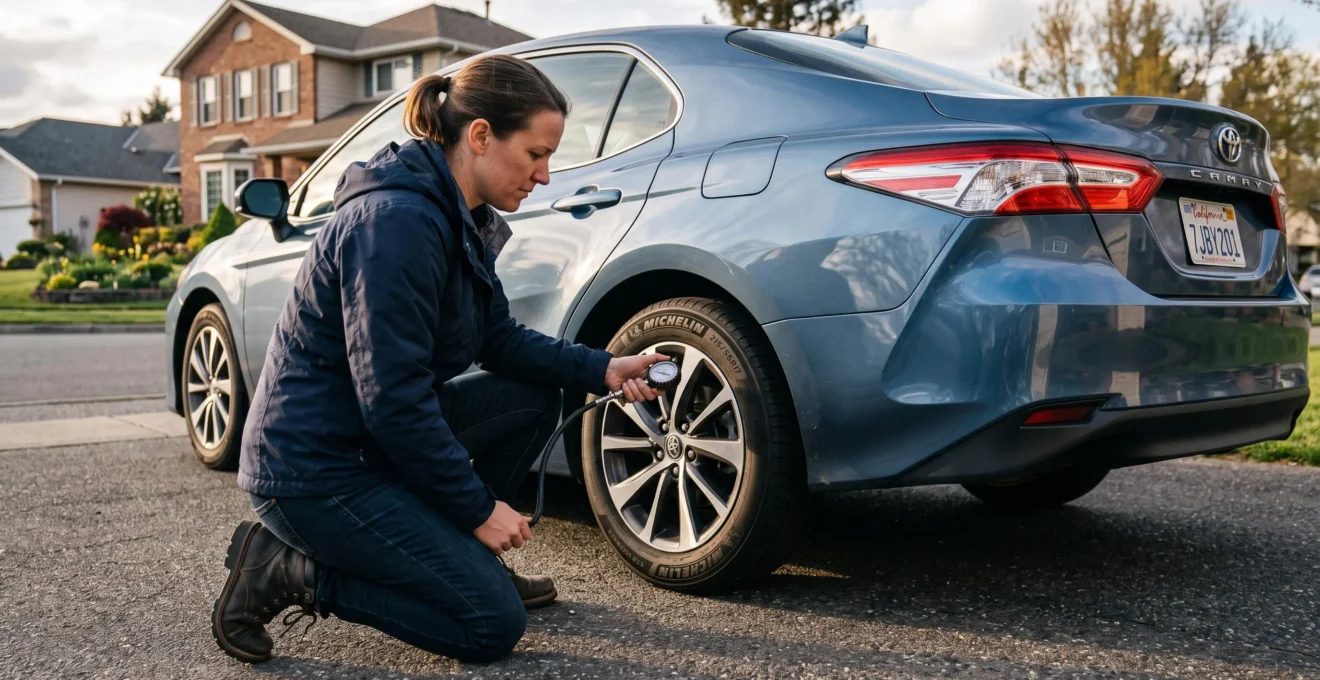
Improving driving safety starts before the engine is switched on. Clean headlights, correctly inflated tyres, functioning brakes and an organised driving environment reduce avoidable risks during ordinary journeys. These precautions matter just as much on a familiar commute or a school run as they do on a long motorway trip.
Vehicle condition and driving behaviour are closely connected. Poor visibility leaves less time to recognise hazards, incorrect tyre pressure can compromise vehicle control, and dashboard distractions can delay a driver’s response to changing traffic. Rain, frost and fog can further reduce the safety margins available under normal conditions.
The most effective approach combines routine maintenance with practical decisions: checking essential components before longer journeys, preparing the cabin before departure, keeping emergency equipment accessible and adapting driving techniques to road conditions. None of these actions guarantees protection from every incident, but together they address preventable weaknesses that drivers can control.
Everyday driving safety essentials
- Maintain clear visibility, correct tyre pressures, reliable brakes and functioning lights before problems affect vehicle control.
- Prepare navigation and cabin settings before moving, and adjust speed and following distance when road conditions deteriorate.
- Keep essential emergency equipment accessible and prioritise regular maintenance over unnecessary safety accessories.
- Why Dirty Headlights and Windscreens Increase Night-Driving Risks
- How to Perform a Five-Minute Safety Check Before a Motorway Trip?
- Which Emergency Safety Items Should You Keep Within Reach in Your Car?
- Common Dashboard Distractions That Make Urban Driving More Dangerous
- When Should You Adjust Your Driving Routine for Rain, Frost or Fog?
- How Incorrect Tyre Pressure Can Reduce Cornering Grip
- Coated or Uncoated Brake Discs: Which Make Sense for Daily Driving?
- Which Car Safety Equipment Matters Most for Everyday Protection?
Why Dirty Headlights and Windscreens Increase Night-Driving Risks
Dirty headlights and windscreens increase night-driving risks because they reduce usable visibility while creating additional glare. Contamination on glass scatters incoming light, while cloudy headlight lenses can distort the projected beam. Drivers may consequently notice pedestrians, road markings or obstacles later, even when their lights and wipers appear to function normally.
At night, the windscreen becomes part of a more demanding visual environment. Oncoming headlights, streetlights and illuminated signs create bright points against darker surroundings. Greasy films, dust and dried cleaning residue can scatter this light, producing halos and reflections that obscure details beyond the glass.
The inside surface deserves particular attention. A windscreen can appear clean from outside while retaining an interior film that becomes noticeable only when another vehicle approaches. Cleaning both sides with an appropriate automotive glass product and a clean microfibre cloth helps remove these deposits.
Headlight lenses experience a different form of deterioration. Exposure to ultraviolet light, abrasion and environmental contamination can leave plastic lenses cloudy or yellowed. This deterioration may reduce useful illumination or disturb the intended light distribution.
These problems often develop gradually. A driver who uses the same vehicle every day may adapt to its declining light output without recognising the change. A simple preliminary comparison involves parking on level ground facing a wall after dark and observing whether the two headlight patterns appear unusually different. This is not a substitute for professional beam-alignment testing, but it may reveal a problem worth investigating.
Cleaning should address the actual cause. Ordinary washing removes surface dirt, but it cannot necessarily restore a lens whose protective surface has degraded. Appropriate lens restoration may help, although severely damaged components may require replacement. Wiper blades that smear or leave unwiped areas should also be inspected and replaced when necessary.
The UK Department for Transport reinforces these priorities through the Highway Code’s vehicle maintenance requirements, which address clean windows, lights, wipers and correctly adjusted lighting.
Good visibility is the foundation for recognising hazards early. Once that foundation is maintained, the next priority is checking whether the vehicle itself is ready for a demanding journey.
How to Perform a Five-Minute Safety Check Before a Motorway Trip?
A five-minute motorway safety check should cover tyres, essential fluids, lights, fuel or battery charge, and luggage security. Each inspection needs a clear pass-or-fail outcome rather than a quick visual glance. Any defect that compromises safe vehicle operation should be resolved before departure, particularly when the journey involves sustained high speeds.
Motorway journeys place continuous demands on tyres, cooling systems and other mechanical components. Higher sustained speeds can increase heat buildup, while a breakdown may expose occupants to fast-moving traffic. A vehicle that seems satisfactory during short local trips may still have a developing fault worth finding before a longer drive.
The most commonly overlooked inspection is cold tyre pressure. Tyres warm during use, increasing their internal pressure and potentially hiding an under-inflation problem. Measure pressures before driving, preferably after the vehicle has been parked long enough for the tyres to cool. Compare the readings with the vehicle manufacturer’s recommendations, not the maximum pressure printed on the tyre sidewall.
The following sequence is intended as a quick screening routine, not a replacement for scheduled servicing. If a measurement or fault requires further investigation, the inspection should take longer than five minutes.
Your five-step pre-motorway safety checklist
- Measure tyre condition and pressure: Check cold pressures against the correct manufacturer values for the planned load, and inspect visible tread and sidewalls. Deliverable: all tyres confirmed at their recommended pressures, with no visible damage requiring attention.
- Inspect essential fluid levels: Check engine oil, coolant and other accessible reservoirs according to the owner’s manual. Deliverable: levels within their specified ranges, with no unexplained loss or visible leakage.
- Test the vehicle’s lights: Verify headlights, indicators, brake lights and other required lighting. Deliverable: functioning lamps without intermittent faults.
- Confirm journey range: Check that the fuel level or available battery charge comfortably covers the planned route and reasonable contingencies. Deliverable: a viable refuelling or charging plan.
- Secure luggage and cabin objects: Restrain loose items, confirm the boot closes securely and keep the driver’s footwell clear. Deliverable: no unsecured load or object that could interfere with vehicle control.
Borderline results require decisions, not assumptions. A tyre below its specified pressure should be corrected before departure, then monitored if pressure loss is suspected. An intermittent bulb needs repair, especially where the affected light is necessary for the intended journey. Fluids near their minimum marks should be assessed against the manufacturer’s instructions; an unexplained reduction or warning light requires investigation.
Do not continue with a suspected brake fault, significant fluid leak, damaged tyre or other serious safety defect. Mechanical problems that cannot be resolved confidently should be assessed by a qualified professional.
Preparation also includes planning for the unexpected. Even a carefully maintained vehicle can suffer a breakdown, making accessible emergency equipment the next important consideration.
Which Emergency Safety Items Should You Keep Within Reach in Your Car?
The most useful emergency safety items are those that help occupants remain visible, communicate and respond safely without unnecessary exposure to moving traffic. A high-visibility vest, charged phone, torch and suitable first-aid supplies deserve accessible storage. Other items can remain secured elsewhere in the vehicle, provided they can be retrieved safely when circumstances permit.
Storage location matters because the boot may be inaccessible or unsafe to approach after a breakdown. Luggage can obstruct emergency supplies, and opening the boot beside fast-moving traffic may create additional danger.
However, accessibility does not mean leaving unsecured objects in the passenger footwell or loose around the cabin. Equipment should remain in closed compartments, suitable organisers or other restrained storage areas where it cannot interfere with the pedals or become a projectile during sudden braking.
Emergency equipment is easier to choose when organised by the problem it addresses.
| Scenario | Useful equipment | Storage and safety priority |
|---|---|---|
| Being seen during a roadside stop | High-visibility vest and hazard warning lights | Keep the vest accessible before leaving the vehicle, where exiting is safe. |
| Warning approaching traffic | Warning triangle where permitted and safe | Check local rules; never place a triangle on a UK motorway. |
| Responding to minor injuries | First-aid kit and protective gloves | Keep supplies organised, secured and within their usable dates. |
| Managing darkness | Working torch | Store it securely in an accessible location and check its power source. |
| Waiting for assistance | Phone charging cable, power bank and drinking water | Maintain communication capability and adapt supplies to journey conditions. |
Equipment requirements differ across countries. A warning triangle, reflective vest or first-aid kit may be compulsory in some jurisdictions but not in others. Drivers travelling internationally should verify the rules for each country rather than assuming that requirements are identical throughout the English-speaking world.
Roadside procedures are equally important. Under the Highway Code’s motorway breakdown and roadside safety rules, drivers should seek a place of relative safety, use appropriate hazard warnings and avoid placing warning triangles on motorways. Occupants should move away from moving traffic when it is safe to do so and seek assistance rather than attempting dangerous roadside repairs.
Emergency kits also need maintenance. First-aid supplies can expire, batteries discharge and reflective materials become damaged or dirty. Checking the kit during routine vehicle servicing or when the clocks change provides a convenient reminder.
As a practical self-check, verify while parked that essential items can be identified and retrieved promptly without searching under luggage. This is an accessibility exercise, not a formal safety standard or a reason to reach for equipment while driving.
Carrying appropriate equipment prepares occupants for unusual events, but reducing everyday risk also depends on maintaining attention during ordinary driving.
Common Dashboard Distractions That Make Urban Driving More Dangerous
Dashboard distractions include touchscreen menus, navigation changes, vehicle notifications, audio controls and climate adjustments. These tasks can divert visual, manual or mental attention from the road. In urban traffic, even a brief distraction may coincide with a pedestrian crossing, a cyclist changing position or another vehicle braking unexpectedly.
Modern cockpits concentrate numerous functions into displays that demand visual confirmation. A driver may need to locate an icon, interpret a submenu, make a selection and check whether the command succeeded. Each stage competes with the attention required for safe driving.
The problem extends beyond time spent looking away. After interacting with a screen, the driver must re-establish awareness of surrounding traffic. During that interruption, another road user may have moved into a position requiring immediate action.
Urban environments make these attention gaps particularly consequential. Parked vehicles can conceal pedestrians, cyclists may approach alongside traffic, and junctions can require simultaneous observation of several directions. A dashboard interaction that feels routine may therefore occur at precisely the wrong moment.
The safest response is to reduce the need for interaction before departure. Configure the route, audio, cabin temperature and other frequently used settings while parked. Enable suitable driving or notification modes where available, and familiarise yourself with essential physical controls.
A useful principle is to postpone any non-essential interaction that requires searching through menus, reading extended text or repeatedly checking a display. Even a single glance is not automatically safe: the immediate traffic situation determines whether attention can be diverted at all.
Voice commands and steering-wheel controls may reduce certain manual demands, but they can still consume mental attention. They should not be treated as permission to undertake complex tasks while driving.
The UK Highway Code explicitly identifies navigation and multimedia systems as potential distractions in the Highway Code’s rules on driver distraction and in-vehicle technology. It also advises drivers to stop safely when an activity requires attention that cannot be given safely while moving.
Keeping attention on the road improves the opportunity to recognise hazards. That opportunity becomes even more important when weather conditions reduce visibility, tyre grip or the available stopping distance.
When Should You Adjust Your Driving Routine for Rain, Frost or Fog?
Adjust your driving routine whenever rain reduces tyre grip or creates standing water, frost may make surfaces slippery, or fog limits the distance you can see ahead. The appropriate response depends on the hazard: increase following distance on wet roads, use gentle controls where ice is possible, and reduce speed while selecting suitable lights in poor visibility.
Different weather conditions change vehicle behaviour in different ways. Applying the same response to every situation overlooks the mechanisms that create risk.
| Condition | Warning signs | Practical response |
|---|---|---|
| Heavy rain | Standing water, substantial spray, reduced visibility or steering that feels unusually light | Reduce speed, increase following distance, avoid deep water and allow more braking space. |
| Frost or ice | Freezing conditions, frost warnings, shaded roads or exposed bridges | Check forecasts, allow extra journey time and use gentle steering, acceleration and braking. |
| Fog | Road features or vehicles becoming difficult to distinguish at a safe distance | Slow down, increase separation and use appropriate dipped headlights and fog lights when conditions require them. |
Rain reduces the friction available between tyres and the road. Standing water can create aquaplaning, where a tyre loses effective contact with the road surface because it cannot displace water sufficiently.
If steering suddenly becomes unresponsive on a wet road, avoid abrupt steering movements or harsh braking. Ease off the accelerator and allow the vehicle to slow progressively while maintaining a steady, appropriate steering input. Normal control should return as the tyres regain contact, although the safest response depends on the situation.
At least twice
The UK Highway Code advises that stopping distances in wet weather will be at least twice those required on dry roads. This is general road safety guidance, not a precise calculation for every vehicle, speed or surface.
UK Department for Transport, Highway Code, Rule 227.
Frost introduces a different risk: surfaces can be slippery even when they appear dry. Bridges, exposed sections and shaded roads deserve particular caution because their surface conditions can differ from surrounding roads.
Where ice is present, the UK Highway Code warns that stopping distances can be ten times greater than on dry roads. Such guidance reinforces the importance of leaving substantial space and avoiding sudden control inputs. When severe ice or snow is forecast, postponing a non-essential journey may be the safer decision.
Fog primarily reduces the distance over which hazards can be identified. In the UK, the Highway Code generally treats visibility below 100 metres as seriously reduced for the purposes of its headlight guidance. Drivers elsewhere should follow their local lighting regulations.
High beams can reflect from fog and worsen the driver’s view. Fog lights should be used only when appropriate and switched off once visibility improves, so they do not dazzle other road users.
The condition of wipers, headlights and tyres becomes especially important in these circumstances. Weather adaptation cannot fully compensate for badly maintained equipment.
Because tyre grip affects braking and steering in both normal and adverse conditions, understanding tyre pressure is a particularly useful next step.
How Incorrect Tyre Pressure Can Reduce Cornering Grip
Incorrect tyre pressure can reduce cornering grip by changing how a tyre deforms and interacts with the road. Under-inflation increases sidewall flex and heat generation, while excessive inflation changes the contact patch and load distribution. Either condition can compromise handling, particularly during an emergency manoeuvre or on a slippery surface.
A tyre must transmit lateral forces when a vehicle turns. Its ability to do so depends on tyre construction, compound, road conditions, load, temperature and inflation pressure.
When pressure is too low, the sidewalls deform more than intended. Excessive flex can increase heat buildup, alter steering response and make the vehicle feel less precise. Severe under-inflation also raises the risk of tyre damage or failure.
Excessive pressure changes how the tread contacts the road and can reduce compliance over uneven surfaces. Although the relationship between contact-patch size and grip is more complex than a simple larger-is-better rule, pressures outside the manufacturer’s specified range can impair handling and braking characteristics.
The problem is often difficult to recognise from the driver’s seat. Gradual pressure loss may be accompanied by small changes in steering feel that become familiar over time. A tyre may also appear normal despite being under-inflated.
Use the manufacturer’s pressure placard, usually found on the driver’s door frame or another specified vehicle location. The owner’s manual provides additional guidance.
Pay attention to the driving conditions specified beside the pressure values. Front and rear tyres may require different pressures, and a fully loaded vehicle may need different settings from one carrying only its driver.
Tyre pressure monitoring systems provide valuable warnings, but they are not a replacement for maintenance checks. Some systems estimate pressure loss from wheel-speed differences rather than measuring pressure directly. Others use individual sensors. Neither arrangement should be assumed to provide a complete assessment of tyre condition.
Measure pressures with a suitable gauge when the tyres are cold, following the vehicle manufacturer’s guidance. If a tyre repeatedly loses pressure, investigate the cause rather than continually topping it up.
Correct pressure is also only one part of tyre safety. Tread condition, damage, age, alignment and the suitability of the tyre for the vehicle and weather conditions all matter.
Tyres determine how effectively braking forces reach the road, but reliable deceleration also depends on the condition and compatibility of the braking components themselves.
Coated or Uncoated Brake Discs: Which Make Sense for Daily Driving?
For everyday driving, coated brake discs can be a sensible choice where corrosion is common, while suitable uncoated discs can provide equally appropriate braking performance. The coating is primarily intended to protect exposed metal surfaces from corrosion. It should not be confused with an upgrade that automatically improves friction, shortens stopping distances or replaces proper brake maintenance.
Brake discs, also called brake rotors, are exposed to water, dirt and potentially corrosive road treatments. On conventional cast-iron discs, visible surface rust can develop when a vehicle is parked in damp conditions.
Some replacement discs feature protective coatings applied during manufacturing. Depending on the product, these treatments can help protect exposed areas such as the hub and outer edges.
On conventional coated rotors, coating present on the braking surface is generally removed as the pads contact the disc during initial use. The remaining corrosion protection is therefore most relevant to the non-friction surfaces.
Coating systems and installation requirements vary by manufacturer. Specific product instructions should always take precedence over assumptions about how a disc is treated or prepared.
The practical choice depends more on operating conditions than on the appearance of the disc.
| Decision factor | Coated discs | Uncoated discs |
|---|---|---|
| Corrosion exposure | Protective treatment may reduce visible corrosion on covered non-friction surfaces. | Exposed surfaces have less protection against environmental corrosion. |
| Daily braking performance | Depends primarily on the complete brake system, including disc and pad specifications. | Can provide suitable everyday braking when correctly specified and maintained. |
| Coastal or salted roads | May offer a practical advantage where corrosion is frequent. | May require greater attention to visible corrosion on exposed components. |
| Purchase decision | Consider coating quality, compatibility and manufacturer guidance. | Consider component quality, compatibility and the vehicle’s operating conditions. |
The more important technical decision involves matching discs and pads correctly. Brake pads use specific friction materials, and discs are manufactured to particular dimensions and specifications. Components must be compatible with the vehicle and suitable for their intended application.
Replacing discs while retaining excessively worn or unsuitable pads can undermine the quality of the repair. Likewise, fitting a specialised performance pad does not automatically improve braking on a standard road vehicle; temperature range, noise, wear and intended operating conditions all influence the result.
New brake components may require an initial bedding-in process. Follow the component manufacturer’s instructions and have the system inspected if unusual vibration, pulling, noises or reduced braking effectiveness occur.
Persistent corrosion, sticking calipers and other mechanical defects deserve more attention than cosmetic differences between coated and uncoated products. A coating cannot prevent every form of deterioration or compensate for neglected maintenance.
Braking safety is ultimately a property of the complete vehicle. This provides a useful basis for deciding which safety equipment and maintenance priorities deserve attention first.
Key takeaways before choosing safety equipment
- Resolve existing safety defects before spending money on optional accessories.
- Choose equipment according to the journeys, passengers and weather conditions you actually encounter.
- Distinguish protective systems already built into the vehicle from items that require regular driver checks or replacement.
Which Car Safety Equipment Matters Most for Everyday Protection?
The most important everyday car safety equipment includes properly maintained tyres, effective brakes, functioning lights, clear wipers, correctly used seatbelts and appropriate child restraints. Built-in protection systems such as airbags and crumple zones also matter, but drivers have more direct control over maintenance, correct use and the accessibility of essential emergency supplies.
A practical safety hierarchy begins with equipment used on every journey. Tyres, brakes, visibility systems and seatbelts influence routine vehicle control and occupant protection. Their condition matters repeatedly, not only during rare emergencies.
Passive safety systems provide another layer of protection. Airbags and energy-absorbing vehicle structures are designed to reduce injury consequences in relevant collision scenarios. They complement, rather than replace, correctly worn seatbelts.
For families, suitable child restraints are especially important. A child seat must be appropriate for the child, compatible with the vehicle and installed according to its instructions. ISOFIX anchoring systems can support correct installation where compatible, but the presence of ISOFIX points does not make every child restraint suitable for every vehicle or child.
Drivers should also distinguish between equipment they can maintain and safety systems that require professional inspection or repair. Faults involving airbags, brake electronics or other vehicle safety systems should not be ignored.
Optional purchases deserve a more selective approach. A jump starter may be useful for a vehicle with an ageing battery or for journeys where assistance is difficult to obtain, provided the device is compatible and used correctly. A portable power bank may be more relevant for ensuring communication during a breakdown.
Meanwhile, an expensive accessory that solves no plausible problem for the vehicle’s actual use may add little practical value.
A useful purchasing test is to ask whether the item addresses an identifiable hazard, whether it can be used safely, and whether it requires maintenance. Equipment that cannot be stored securely or accessed when necessary may not provide the expected benefit.
Safety priorities also change with circumstances. Parents transporting young children need appropriate restraints. Drivers regularly travelling on poorly lit rural roads should pay particular attention to lighting and visibility. Those encountering winter road treatments should inspect corrosion-prone components and maintain suitable tyres.
These choices connect to the earlier principles: clear glass supports perception, correct pressures support handling, sound brakes support deceleration, and attention management supports timely decisions. Emergency equipment helps manage the consequences when prevention is not enough.
Before your next journey, inspect the tyres, confirm that lights and wipers work, secure the cabin and prepare the route while parked. Address any safety defect before setting off, and make these checks part of a repeatable maintenance routine rather than relying on a new accessory to compensate for a preventable risk.
How often should drivers check tyre pressure?
The UK Highway Code recommends checking tyre pressure weekly before driving, while the tyres are cold. Use the vehicle manufacturer’s recommended values for the expected load. Check sooner if a warning appears, a tyre looks damaged or pressure loss is suspected. Follow any additional guidance in the vehicle manual.
Can a car be unsafe even when no dashboard warning lights are displayed?
Yes. Warning systems do not detect every mechanical or maintenance problem. Worn wiper blades, dirty headlight lenses, certain tyre defects and unsecured luggage may create risks without triggering a dashboard alert. Regular physical inspections and scheduled servicing remain necessary.
Should you continue driving if the brakes make an unusual noise?
Unusual brake noises should be investigated rather than ignored. Their causes can range from temporary surface conditions to worn or damaged components. If braking performance changes, the pedal feels abnormal, or the vehicle pulls noticeably when braking, stop safely and arrange professional assistance rather than continuing the journey.
Is a warning triangle required in every car?
No universal requirement applies across all English-speaking countries. Rules vary by jurisdiction and sometimes by vehicle category. In the UK, the Highway Code specifically instructs drivers not to place warning triangles on motorways. Check the rules applicable to your route and never put yourself at risk to deploy warning equipment.
What should a driver do when visibility becomes too poor to continue safely?
Reduce speed progressively, increase following distance and use the appropriate lights. If conditions become too severe for safe progress, find a suitable place away from moving traffic to stop. Avoid sudden manoeuvres or stopping in a live traffic lane unless an emergency makes it unavoidable. Resume only when conditions permit safe driving.