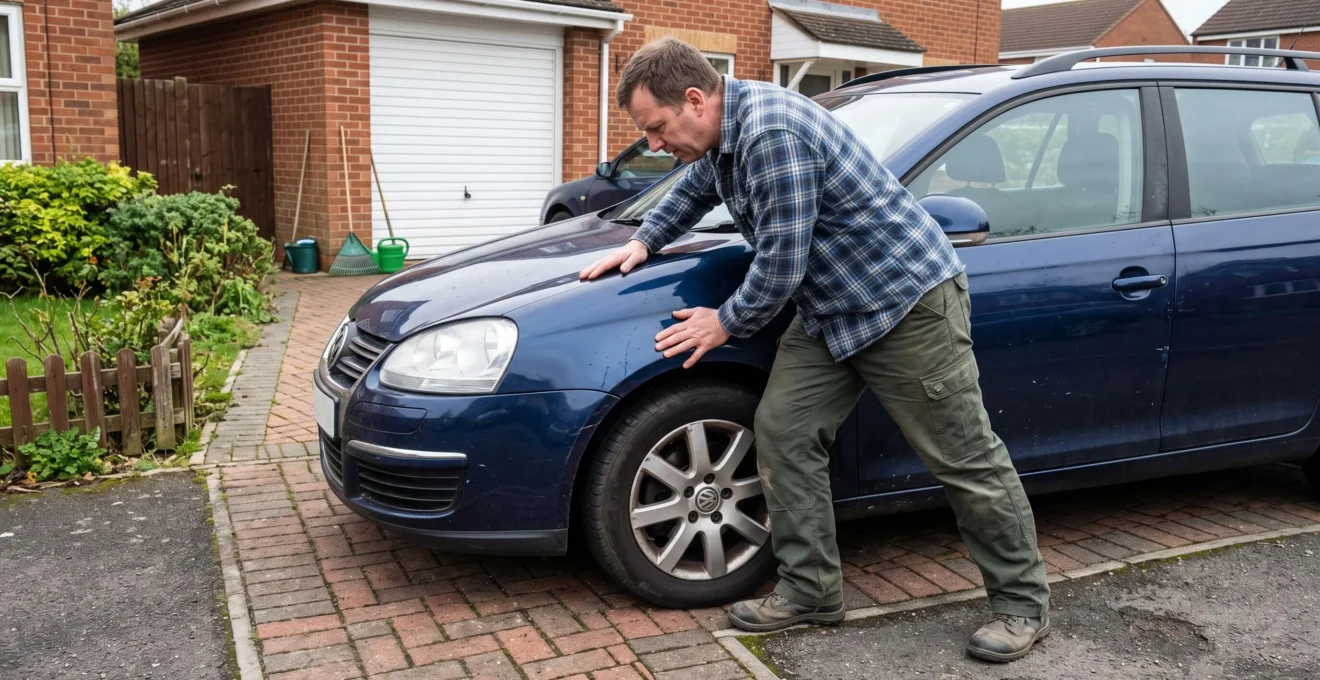
A car that continues bouncing after a bump, knocks over uneven roads or feels unsettled through corners may be developing a suspension fault. These changes are more than comfort problems. The suspension must control body movement, maintain wheel alignment and help tyres remain in reliable contact with the road.
Worn shock absorbers, damaged springs, loose ball joints and deteriorated bushes can produce overlapping symptoms. Some develop gradually, making changes difficult to recognise. Others follow a pothole impact or rough-road journey and can become dangerous without much warning.
The most useful early indicators are persistent bouncing, new suspension noises, uneven ride height, unusual tyre wear and changes in steering stability. Checking when each symptom occurs helps distinguish a likely suspension problem from tyre pressure, wheel imbalance or braking faults.
Simple observations can reveal whether professional inspection is needed. They cannot reliably establish the condition of every suspension component, particularly where hidden wear or safety-critical joints are involved.
Suspension problems: the essential warning signs
- Repeated bouncing: Continued oscillation after a bump or a push-down test suggests inadequate damping and potentially inconsistent tyre contact.
- Knocks, leaning or steering play: These can indicate damaged springs, bushes or joints. Significant looseness, visible structural damage or an unstable wheel requires urgent attention.
- Abnormal tyre wear: Cupping, feathering and one-sided tread wear can reveal suspension, alignment or wheel-balance problems that should be diagnosed before replacing tyres.
- Why Does Your Car Bounce Repeatedly After Driving Over a Bump?
- How to Identify Suspension Knocks on Uneven Roads?
- Shock Absorber or Coil Spring Fault: Which Signs Matter?
- Why a Worn Ball Joint Should Never Be Ignored
- When Is Wheel Alignment Needed After Suspension Repairs?
- How to Read Tyre Wear Patterns That Suggest Handling Problems?
- What Should You Inspect After Driving on Deeply Rutted Tracks?
- Why Your Car Loses Road Holding in Corners and on Wet Roads
Why Does Your Car Bounce Repeatedly After Driving Over a Bump?
A car that keeps bouncing after crossing a bump may have worn shock absorbers or dampers. Springs compress to absorb road impacts, while dampers control the energy released as the springs return to position. When damping deteriorates, the suspension can oscillate repeatedly instead of settling promptly, reducing stability and making tyre contact less consistent.
Normal suspension movement includes compression and rebound. A sharp bump may produce a noticeable body movement, particularly in a softly sprung vehicle. The important distinction is whether that movement settles quickly or continues through several obvious up-and-down cycles.
A practical preliminary check is the push-down bounce test:
- Park on firm, level ground, switch off the engine and secure the vehicle.
- With the vehicle stationary, press firmly down on a structurally suitable point near one corner, avoiding fragile body panels.
- Release the pressure and observe how the body rises and settles.
- Repeat at the other corners where the vehicle design allows a safe, meaningful test.
A serviceable suspension will generally settle promptly, often within approximately one rebound cycle. Repeated oscillation is suspicious, but this is not a validated numerical pass-or-fail threshold. Vehicle design, suspension stiffness and the amount of movement generated can influence the result.
The Highway Code‘s vehicle maintenance and safety guidance identifies continued bouncing after pressing down on a vehicle as a warning sign of worn shock absorbers.
Bouncing at only one corner is especially important. A single weak damper may allow that wheel to oscillate differently from the opposite wheel, producing asymmetric responses during braking, steering or sudden changes of direction.
The underlying risk is inconsistent tyre contact. If a wheel repeatedly unloads over an uneven surface, the tyre cannot generate its normal grip throughout that movement. This can make the car feel unsettled even when the tyre tread appears satisfactory.
A car may also pass a basic bounce test despite having dampers that perform poorly under driving conditions. A professional inspection or suitable damper assessment is therefore appropriate when road symptoms persist.
Repeated bouncing is an early warning, but it is not the only one. Damaged joints and mounting components often announce themselves through noises before handling noticeably deteriorates.
How to Identify Suspension Knocks on Uneven Roads?
Suspension knocks are most useful diagnostically when their location, frequency and triggering movement are identified. A sharp knock over a bump may indicate play in a joint or anti-roll bar link, while a deeper clunk can originate from a worn bush, damper mounting or damaged spring support. Sound alone cannot identify the faulty component reliably.
Begin by observing whether the sound occurs during compression, rebound, steering or changes in acceleration. A noise heard over isolated sharp ridges may have a different cause from one that appears while turning the steering wheel.
The following sound patterns provide starting points for inspection rather than definitive diagnoses.
| Sound and situation | Possible components | Useful distinguishing clue |
|---|---|---|
| Sharp knock from the front over small bumps | Ball joints, anti-roll bar links, damper mounts | Occurs during rapid wheel movement |
| Heavy clunk from the rear during compression | Suspension bushes, spring seats, damper mounts | May become more noticeable with passengers or luggage |
| Clunk associated with low-speed steering changes | Track rod ends, steering joints, suspension joints | Sound may coincide with steering movement or looseness |
| Metallic rattle over rough surfaces | Broken spring fragment, loose mounting or non-suspension component | Requires visual inspection to distinguish the source |
Cabin acoustics can make localisation deceptive. A knock perceived near the driver’s feet may originate from the opposite wheel because vibration travels through the subframe and body structure.
A passenger may help identify the general area while the vehicle crosses a familiar speed bump slowly and safely. However, avoid repeated test drives when steering play, severe clunking or wheel instability is suspected.
Not every rattle comes from the suspension. Exhaust heat shields, loose interior trim and underbody panels can produce similar sounds. A suspension-related knock often corresponds closely with wheel movement and disappears on smooth roads. Non-suspension rattles may also occur with engine vibration or body movement, although these patterns overlap.
A useful stationary comparison is to check for loose items inside the car and note whether the noise changes with the engine running or when the body is gently moved. Never place yourself beneath an unsupported vehicle or reach near moving components.
A sudden new knock accompanied by a change in steering or ride height deserves prompt professional assessment rather than continued experimentation.
Once the likely corner has been identified, comparing damper behaviour with spring condition helps narrow the fault without assuming every noise is caused by a worn shock absorber.
Shock Absorber or Coil Spring Fault: Which Signs Matter?
Shock absorber and coil spring faults differ mainly in how they affect suspension movement and ride height. Worn dampers generally produce excessive oscillation, nose-diving or a floating sensation. Broken or sagging springs can cause a lower ride height, metallic knocking or visible damage. Both faults may reduce stability, and some symptoms overlap.
The spring supports the vehicle and allows the suspension to move over road irregularities. The damper controls the speed of that movement. A weakened spring changes how the vehicle sits and responds to load, while a worn damper allows movement to continue for too long.
| Diagnostic sign | Worn shock absorber | Damaged coil spring |
|---|---|---|
| Typical development | Often gradual loss of damping | May sag progressively or fracture suddenly |
| Ride height | Usually remains broadly normal | May drop on one corner |
| Movement | Excessive bouncing, pitching or floating | Altered suspension travel, possible bottoming out |
| Noise | Possible mounting knock or internal noise | Metallic clunk or rattle from a fractured section |
| Visible clues | Significant fluid leakage or physical damage | Broken coil, corrosion, displaced spring seat |
| Useful confirmation | Professional damping and mounting assessment | Visual inspection and ride-height comparison |
A deteriorating damper can allow excessive forward pitching during braking and a delayed settling response after steering inputs. In demanding conditions, poor wheel control may reduce the available braking grip. However, no fixed increase in stopping distance can be assumed without vehicle-specific testing.
Spring fractures can be harder to recognise than expected. Corrosion around the ends of a coil may weaken the metal, particularly where road salt and trapped moisture are present. A small section can break while the remaining spring stays seated.
As a result, a broken spring does not always make the car visibly lean. An intermittent metallic knock may be the first clue. A displaced fragment can subsequently contact a tyre or other component, creating a serious hazard.
Inspect the vehicle from outside on level ground. Compare the distance between each wheel arch and the tyre, accounting for normal design differences, loading and tyre size. Look through the wheel arch for visible spring damage, displaced components or significant damper leakage, without reaching into the assembly.
According to the DVSA’s MOT inspection criteria, a fractured spring and a damper with negligible damping effect can constitute Major defects. The criteria also distinguish severe leakage from minor surface seepage.
When replacing dampers or springs, axle-pair replacement is often recommended to maintain balanced characteristics between the left and right sides. The precise requirement depends on the vehicle, manufacturer instructions, component condition and repair procedure. A workshop should explain whether both sides require replacement.
Damper and spring faults affect how a wheel moves, but worn suspension joints introduce a different concern: the wheel may no longer be held securely in its intended position.
Why a Worn Ball Joint Should Never Be Ignored
A worn suspension ball joint should never be ignored because it helps locate the wheel while allowing steering and suspension movement. As wear increases, the joint can develop excessive play, causing knocking, steering vagueness and alignment changes. In severe cases, joint separation can allow the wheel assembly to move uncontrollably, making the vehicle unsafe to drive.
Ball joints typically connect suspension arms to steering knuckles. Their internal bearing surfaces operate under substantial loads, particularly during cornering, braking and movement over rough roads.
Early wear may produce a slight clunk or vague steering response. With progression, the vehicle may wander, feel less precise or show abnormal tyre wear as wheel geometry becomes inconsistent.
One major warning sign is a damaged protective boot. A split boot can allow water and abrasive dirt into the joint, displacing lubricant and accelerating wear. However, a torn boot alone does not prove that the joint has already developed excessive mechanical play.
Ball joint inspection requires the correct suspension loading method. A mechanic may lift and rock the wheel or apply controlled leverage while observing movement in the joint. The appropriate lifting position depends on whether the joint carries spring load and on the suspension design.
Drivers should not attempt to lever against a suspension joint beneath a vehicle supported only by a jack. A workshop lift or correctly placed rated stands and vehicle-specific technical instructions are essential for any raised-vehicle inspection.
Lower ball joints may produce clunks over bumps, steering vagueness and changes in wheel position under load. Upper ball joints, where fitted, can produce similar symptoms. Track rod ends can also cause steering looseness, but their primary function is to transmit steering movement rather than locate the suspension arm.
A pull under braking is not enough to identify a defective lower ball joint. Brake imbalance, tyre pressure differences and alignment problems must also be considered.
In Great Britain, the DVSA‘s MOT suspension inspection criteria classify excessive suspension-joint wear as a Major defect and a joint likely to become detached as Dangerous. The precise classification depends on the condition and inspection criteria.
Vehicle inspection requirements differ across English-speaking jurisdictions. MOT rules do not apply automatically to US states, Australia or other countries, where roadworthiness inspections and defect enforcement vary.
Continuing to use a vehicle with a known serious defect may also have legal or insurance implications after a collision, depending on local law, causation and the policy involved. An inspection failure does not itself establish accident liability.
Suspected joint separation or severe wheel movement warrants stopping use of the vehicle and arranging recovery. Waiting for the next scheduled service is not an appropriate response.
Once a defective joint or other suspension component has been repaired, the next question is whether the wheel geometry still matches the manufacturer’s specifications.
When Is Wheel Alignment Needed After Suspension Repairs?
Wheel alignment is needed after suspension repairs whenever the work changes, disturbs or may alter wheel geometry. Track rod replacement and adjustments to suspension mounting positions are common examples. Other repairs, including some damper or spring replacements, may also require alignment depending on vehicle design and manufacturer instructions. The repair itself determines the requirement, not simply the component name.
Alignment sets the relevant wheel angles, including toe and camber where adjustable, against the vehicle manufacturer’s specifications. Incorrect angles can cause pulling, an off-centre steering wheel and accelerated tyre wear.
Toe error is particularly damaging because the tyres can be forced to scrub sideways as the vehicle rolls. Even a relatively small deviation may produce progressive feathering and tread loss, although the rate depends on the vehicle, tyre and driving conditions.
Use this repair-based guide when discussing alignment with a workshop.
| Repair or event | Alignment decision | Reason |
|---|---|---|
| Track rod end replacement | Alignment required | Steering toe setting has been disturbed |
| Ball joint or control arm replacement | Check manufacturer procedure; alignment commonly needed | Wheel locating points or geometry may change |
| Strut or damper replacement | Depends on suspension design | Some mounting arrangements affect camber or toe |
| Coil spring replacement | Check ride height, procedure and geometry requirements | Ride-height changes may influence wheel angles |
| Anti-roll bar link replacement | Usually unnecessary if geometry is undisturbed | Links normally do not establish wheel alignment |
| Significant pothole or kerb impact | Geometry and component inspection recommended | Suspension or steering parts may have shifted or bent |
A two-wheel alignment may address front toe on vehicles where only the front settings require correction. A four-wheel geometry measurement assesses front and rear wheel relationships and is particularly useful after significant impacts, rear suspension work or persistent tracking problems.
Some rear axles have limited or no factory adjustment. Measuring their geometry can still reveal damage or a thrust-angle problem. A workshop should distinguish between measuring all four wheels and adjusting all four wheels, which may not be possible.
Wheel balancing is a separate procedure. It corrects uneven mass distribution in a rotating wheel-and-tyre assembly, often associated with speed-related vibration. Alignment corrects wheel angles and tracking.
Michelin‘s explanation of wheel alignment and balancing distinguishes these procedures and recommends alignment checks after significant impacts.
After alignment, verify the result under safe driving conditions. The steering wheel should remain centred when driving straight on suitable level roads, and the vehicle should not consistently pull to one side. Road camber and wind can affect these observations.
Ask for the before-and-after alignment readings when available. Continuing tyre wear, a persistent pull or an off-centre steering wheel should prompt reassessment rather than reliance on the workshop receipt alone.
Correct geometry also makes tyre wear patterns more informative. The shape of existing tread damage can reveal whether a suspension problem has been developing for some time.
How to Read Tyre Wear Patterns That Suggest Handling Problems?
Tyre wear patterns can reveal suspension and alignment faults before handling problems become obvious. Scalloped or cupped tread may indicate poor wheel control or imbalance, feathered edges commonly suggest incorrect toe alignment, and heavy wear on one shoulder can indicate a geometry problem. These patterns are clues, not conclusive diagnoses, and must be interpreted alongside tyre pressure and mechanical condition.
Examine the entire tread width rather than looking only at the most visible outer shoulder. Damage can develop on the inner edge while the tyre appears acceptable from a standing position.
| Wear pattern | Possible cause | Recommended check |
|---|---|---|
| Cupping or scalloping: repeated shallow dips | Worn dampers, wheel imbalance or other wheel-control problems | Inspect dampers, joints and wheel balance |
| One-sided shoulder wear | Incorrect camber, toe or other alignment conditions | Measure wheel geometry and inspect for wear |
| Feathered tread edges | Incorrect toe alignment | Check toe settings and steering components |
| Both shoulders worn | Chronic underinflation or operating conditions | Check cold tyre pressures and loading |
| Centre tread worn | Possible chronic overinflation | Compare pressures with vehicle specifications |
| Localised flat spot | Wheel lock during braking or prolonged stationary storage | Inspect tyres and investigate braking or vibration symptoms |
Cupping is particularly relevant to suspension diagnosis. When a wheel is repeatedly unloaded and reloaded, tread contact and wear can become irregular. However, wheel imbalance can produce a similar pattern, so cupping does not establish that the damper has failed.
On wet roads, reliable contact and effective water evacuation become especially important. Poor damping can disrupt tyre loading over uneven surfaces, while irregular or insufficient tread may further compromise performance. The presence of cupping alone does not establish a measurable increase in aquaplaning risk.
For a more detailed explanation of these patterns, Michelin’s tyre wear-pattern advice identifies suspension wear, imbalance, inflation and alignment among the possible causes.
To inspect safely, park on level ground, switch off the engine and secure the vehicle. Examine the visible tread and, where safe and permitted by the vehicle design, turn the front wheels while stationary to improve visibility of the inner shoulders. Never put hands near a moving wheel.
Use a suitable tread-depth gauge to measure several points across each tyre and at different positions around its circumference. Also check for exposed cords, cuts, bulges and embedded objects.
In the UK, the general minimum for relevant passenger-car tyres is 1.6 mm across the central three-quarters of the tread width and around the full circumference. Requirements elsewhere vary, and meeting a legal minimum does not guarantee good wet-weather performance.
Lightly feeling the tread surface can help identify feathered edges, but inspect visually first for exposed metal, sharp debris or damage that could injure your hand.
Replacing a worn tyre without correcting the underlying geometry, balance or suspension problem can allow the same wear pattern to develop on the replacement. Existing irregular wear also may not disappear after the mechanical fault is repaired.
Tyres also provide evidence after a severe road impact, but damage may extend beyond the tread to suspension components hidden inside the wheel arches.
What Should You Inspect After Driving on Deeply Rutted Tracks?
After driving on deeply rutted tracks, inspect the tyres, wheels, suspension springs, visible dampers and underbody for impact damage. A deep rut can force a wheel through excessive suspension travel or strike a vulnerable component. Fresh leakage, altered ride height, new steering pull or damaged wheel positioning warrants professional inspection, even if the vehicle initially seems driveable.
Start with the vehicle parked securely on firm, level ground. Look for obvious changes in the position of each wheel within its arch, damaged tyre sidewalls or fresh marks on the underbody.
A bent control arm, displaced suspension mounting or shifted subframe may change the wheel’s position. However, visual differences can be subtle, and confirmation often requires measurement on a workshop lift.
Inspect the visible springs for broken ends, displaced seating or new corrosion-related fractures. On accessible dampers, distinguish light surface dirt or minor seepage from fresh, substantial fluid leakage. Damper condition cannot be reliably assessed from an oil film alone.
Mud packed around ball joint boots, bushes and suspension mounts can conceal defects. Once the vehicle is safely accessible, remove loose surface debris using a method appropriate for the components. Avoid high-pressure water directed into damaged seals or electrical connections.
Check again after approximately 24 hours if the initial inspection reveals no serious defect and the car has remained safe to use. Some problems become more noticeable after debris dries or the suspension moves through normal driving conditions.
New knocking, changed steering response, uneven ride height or a developing pull can indicate damage that was not immediately apparent after the impact.
The following checklist helps produce useful observations for a mechanic without requiring the driver to dismantle suspension components.
Five post-impact checks to record before a suspension inspection
- Compare all four corners: Park on level ground, photograph each wheel arch from a consistent angle and record any obvious change in ride height.
- Inspect tyres and wheels: Check sidewalls and visible rims for cuts, bulges or deformation; photograph each suspicious area and note its wheel position.
- Look for fresh leakage: Examine the ground and visible damper bodies without crawling under the car; record the location and appearance of any new fluid.
- Check visible springs and protective boots: Note broken coils, displaced parts or torn rubber covers, using a torch without reaching into the suspension.
- Document changes within 24 hours: If the vehicle is safe to operate, record any newly apparent noise, pull or uneven stance and provide the notes to the workshop.
A quiet initial inspection does not rule out hidden structural damage. If the vehicle has suffered a severe strike, a professional inspection may be justified even without immediately obvious symptoms.
Do not continue driving if a wheel is visibly bent or displaced, a spring is dislodged, steering becomes difficult, the car pulls severely, a tyre rubs against the body or a safety-critical component appears loose. Arrange vehicle recovery.
Significant fresh damper leakage also requires prompt assessment. Whether limited onward movement is safe depends on its severity and associated symptoms; when control is impaired or uncertain, recovery is the safer option.
Impact damage is particularly relevant when the vehicle subsequently feels unstable in corners or on wet roads, where consistent wheel positioning and tyre contact become critical.
Key takeaways before assessing road holding
- Suspension faults become more concerning when several symptoms appear together, such as repeated bouncing combined with tyre cupping or steering pull.
- A sudden change after an impact deserves greater urgency than a stable, longstanding comfort complaint, especially if wheel position or directional control has changed.
- Road-holding problems require a combined assessment of tyres, damping, suspension joints and alignment rather than replacement of a component based on one symptom.
Why Your Car Loses Road Holding in Corners and on Wet Roads
A car can lose road holding in corners or on wet roads when suspension faults prevent the tyres from maintaining consistent loading and contact with the surface. Worn dampers, loose joints, damaged springs and incorrect alignment can all disrupt wheel control. Wet conditions make these problems more noticeable because the available tyre-road grip is already reduced.
Tyres generate the forces needed for steering, braking and acceleration through their contact patches. Suspension components help manage wheel position and vertical movement as the vehicle corners, brakes or crosses uneven surfaces.
A functioning suspension cannot eliminate changes in tyre load, but it helps control those changes. When damping becomes inadequate, the wheels may oscillate after disturbances, temporarily reducing their ability to transmit steering and braking forces.
Different driving situations can reveal different weaknesses.
| Driving situation | Warning behaviour | Possible explanations |
|---|---|---|
| Entering a corner | Excessive roll, delayed settling or vague response | Weak damping, suspension wear, tyres or alignment |
| Exiting a corner | Rear becomes unsettled or loses traction unexpectedly | Rear damping, tyre grip, alignment or other chassis factors |
| Crossing a crest while turning | Front steering response becomes inconsistent | Front wheel unloading, inadequate damping or geometry problems |
| Driving on wet uneven roads | Unexpected instability despite apparently adequate tread | Tyre condition, pressure, drainage, damping or contact variation |
| Braking over bumps | Repeated pitching or poor directional stability | Damper deterioration, suspension looseness, braking or tyre issues |
Excessive body roll does not always mean a damper is faulty. Some vehicles naturally lean more than others, and springs, anti-roll bars, tyre characteristics and vehicle loading also influence roll behaviour. A new or progressively worsening change is more informative than comparing unrelated vehicles.
Likewise, rear instability on corner exit cannot identify failed rear dampers on its own. Tyre grip, road contamination, driver inputs, drivetrain behaviour and stability-control operation may contribute.
In wet conditions, a tyre must maintain grip while managing water between its tread and the road. Poor suspension control can aggravate instability on rough surfaces, but aquaplaning depends on several factors, including water depth, speed, tread condition and tyre design.
Reducing speed is an important immediate precaution when handling feels uncertain. It does not repair the mechanical problem, however. Deliberately lowering tyre pressure below the manufacturer’s recommendation is not an appropriate solution: underinflation can worsen steering response, tyre heating and wear.
Use the vehicle manufacturer’s recommended cold tyre pressures and avoid high-speed driving, abrupt manoeuvres or demanding road conditions while a suspected handling fault remains unresolved.
For practical decision-making, distinguish between three levels of concern.
- Monitor and arrange a routine inspection: Mild, isolated symptoms without steering instability, visible damage or rapid deterioration. Record exactly when the behaviour occurs.
- Book a prompt professional diagnosis: Persistent bouncing, repeated knocking, irregular tyre wear, notable ride-height changes or new instability after an impact. Avoid demanding driving until assessed.
- Stop driving and arrange recovery: Severe steering looseness, suspected joint separation, a displaced wheel, broken components threatening a tyre, serious tyre damage or a vehicle that cannot be controlled predictably.
When contacting a workshop, describe the location and circumstances of each symptom. For example, explain whether the car bounces repeatedly at the rear after a bump, knocks during low-speed steering, pulls after a pothole strike or shows scalloped tread on one wheel.
Include when the issue began, whether it is getting worse, recent repairs and any photographs of tyre wear or visible damage. These observations can help the technician determine which tests and components deserve priority.
The next step is a targeted suspension and tyre inspection whenever road holding has noticeably changed. Avoid relying on driving adjustments to compensate for suspected component wear. A qualified technician can assess damper performance, suspension-joint integrity, spring condition and wheel geometry, then identify the repair needed to restore predictable handling.
Can a car pass an inspection and still have worn shock absorbers?
Yes. Inspection procedures assess defined defects and may not detect every early loss of damping performance. A vehicle can develop poor wheel control before a defect becomes obvious during a routine inspection. Persistent bouncing or unstable handling warrants investigation even when the vehicle has a valid inspection certificate.
Is it safe to drive with a small suspension knock?
The sound alone does not establish whether driving is safe. A small knock may come from a relatively minor loose component or a joint approaching serious failure. Arrange an inspection promptly, especially if the noise is new or worsening. Do not drive if steering, wheel position or vehicle stability is compromised.
Can worn suspension parts damage brand-new tyres?
Yes. Worn joints, ineffective dampers and incorrect wheel geometry can produce irregular tread wear on replacement tyres. Correcting the underlying mechanical defect before fitting new tyres reduces the risk of repeating the same damage. Existing irregular wear may remain visible after the fault is repaired.
Does a steering wheel vibration always mean a suspension fault?
No. Wheel imbalance, tyre damage, wheel distortion and braking problems can also cause vibration. A vibration that changes with road speed may point towards wheel or tyre balance, while one associated with bumps or steering movement may justify closer suspension and steering inspection. The precise cause requires testing.
Should shock absorbers be replaced before they start leaking?
They may need replacement if damping performance has deteriorated significantly, even without visible leakage. Internal wear can reduce effectiveness before an external oil leak appears. Conversely, a light film of fluid does not automatically prove that a damper has failed. Road symptoms, physical condition and an appropriate professional assessment should guide the decision.