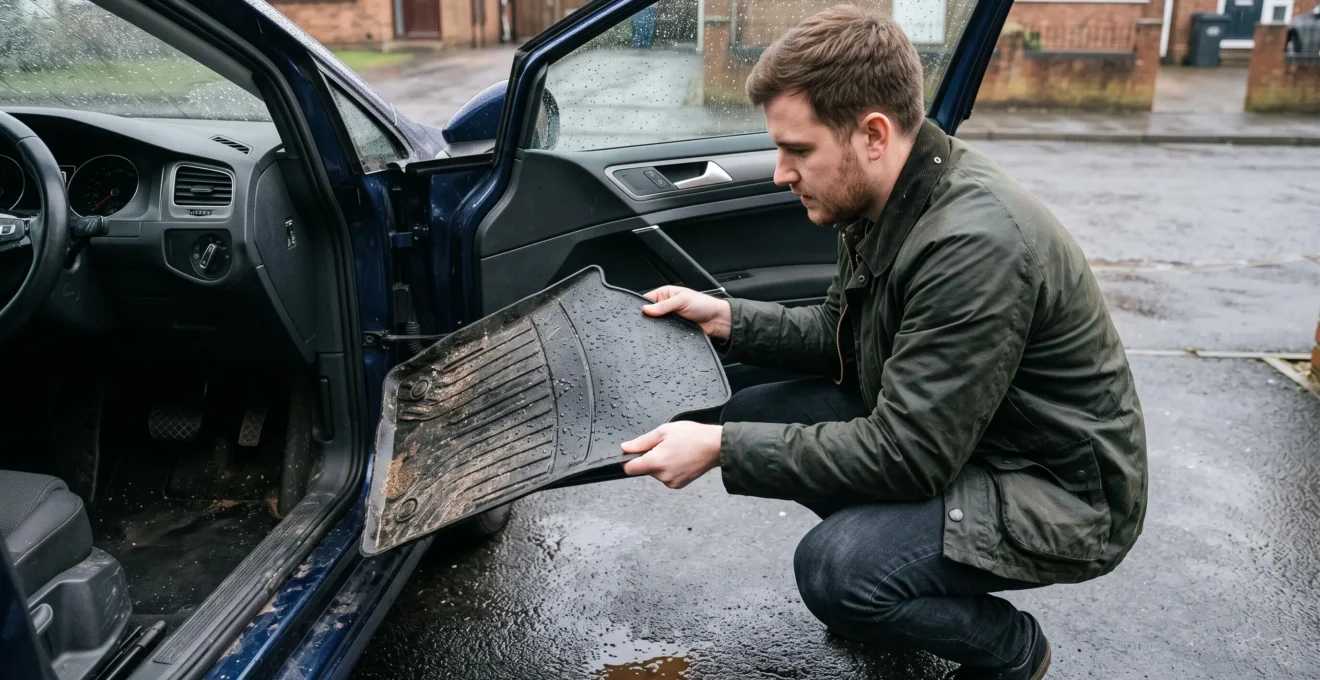
Wet shoes, muddy equipment and repeated passenger journeys can gradually damage a vehicle’s original flooring. Dirt becomes embedded in carpet fibres, moisture collects beneath removable mats, and everyday friction wears down the areas around the pedals. What initially looks like a cleaning problem can eventually become a hidden moisture or corrosion issue.
Protecting vehicle flooring requires more than placing a mat over the carpet. Effective protection combines correctly fitted floor liners, regular moisture checks, prompt spill treatment and enough ventilation to dry the underlying materials. The aim is to prevent water and abrasive debris from reaching vulnerable surfaces while ensuring that protective accessories do not interfere with driving controls.
The appropriate approach depends on how the vehicle is used. A family car carrying passengers in rainy weather faces different conditions from a vehicle regularly transporting muddy tools, sports equipment or snow-covered footwear. Understanding where moisture collects, how flooring materials behave and when protective mats need attention helps preserve the original interior without unnecessary replacement.
Essential vehicle floor protection tips
- Use vehicle-compatible mats or liners with secure retention points, sufficient coverage and raised edges where wet conditions demand them.
- Inspect beneath removable mats regularly: a dry-looking surface can conceal damp carpet backing or insulation.
- Remove moisture promptly, identify recurring water sources and dry the underlying padding before odours or corrosion develop.
- Why Does Moisture Under Car Carpets Cause Persistent Odours?
- How to Find the Source of Water Beneath Your Car Carpet?
- Rubber Floor Liners or Original Carpeting: Which Handles Mud Better?
- The Hidden Rust Risks of Leaving Car Footwells Damp
- What to Do After Spilling a Large Drink onto Car Carpeting?
- Rubber or Carpet Mats: Which Last Longer in Wet Conditions?
- Why Do Some Seat Covers Trap Heat and Moisture During Summer?
- How to Choose Durable Non-Slip Car Mats That Stay Secure Underfoot?
Why Does Moisture Under Car Carpets Cause Persistent Odours?
Persistent odours develop when moisture remains trapped beneath vehicle carpeting, creating conditions that can support mould and microbial growth. The carpet backing and underlying insulation may stay damp long after the visible surface feels dry. Cleaning the top layer alone therefore cannot reliably eliminate the smell if the moisture source remains underneath.
Vehicle flooring is made from several layers. The visible carpet covers backing materials, insulation and sometimes thick sound-deadening padding. These underlying components can retain water from wet footwear, spills or leaks. Because they receive little airflow, drying may be considerably slower than at the carpet surface.
As trapped moisture persists, musty odours can develop in concealed areas. The EPA guidance on mould and moisture prevention identifies the underside of carpets and pads as possible locations for hidden mould. Although this guidance concerns buildings rather than vehicles, the underlying principle is relevant: controlling moisture is essential to preventing recurring mould problems.
A dirty removable mat usually produces an odour associated with its exposed surface. Hidden moisture is more likely when the smell returns after cleaning, intensifies after the cabin has been closed or accompanies unexplained window condensation. These signs are suggestive rather than conclusive, so the underlying material should be checked.
For a simple preliminary check, remove the mat and carefully lift an accessible carpet edge without forcing trim or disturbing electrical components. Press a clean paper towel against the padding and inspect it for transferred moisture or staining. Notice whether the exposed material smells musty. After allowing safe ventilation, check again approximately 24 hours later. This is a practical screening method, not a validated diagnostic test.
24–48 hours
The EPA recommends drying wet materials within this period to help prevent mould growth in indoor environments. This is useful general prevention guidance, not a scientifically established drying deadline for automotive carpet assemblies.
United States Environmental Protection Agency, A Brief Guide to Mold, Moisture and Your Home.
If the padding remains damp, applying fragrance or repeatedly shampooing the visible carpet will not resolve the underlying problem. The moisture must be removed and its source identified.
Persistent odour is often a useful warning sign, but it does not identify where the water entered. Finding that source is the next step in preventing repeated damage.
How to Find the Source of Water Beneath Your Car Carpet?
To find water beneath a car carpet, first establish when the dampness appears, then inspect the entry points that match those conditions. Rain-related moisture suggests seals, drains or body openings, while water appearing after air-conditioning use may indicate an HVAC drainage problem. Wet footwear and equipment can also introduce moisture without any vehicle leak.
Start by removing the affected floor mat and examining the edges of the footwell. Water marks, discolouration and damp patches can indicate the direction from which moisture travelled, although water may migrate along the floor pan before becoming visible.
Use the following inspection sequence, adjusting the order to match the symptoms:
- Door and window seals: Look for damaged rubber, displaced weatherstripping, blocked door drainage openings and staining near the sill.
- Sunroof drains: On vehicles equipped with a sunroof, inspect accessible drain areas for debris or overflow. Avoid forcing tools or compressed air into delicate drain tubing.
- Windscreen bonding: Check for moisture around the dashboard edges and windscreen pillars, particularly if the glass has previously been replaced.
- Underbody plugs and seams: Look for missing plugs or damaged sealing around the floor structure. Have inaccessible or potentially structural areas inspected professionally.
- HVAC condensate drain: Consider an obstructed evaporator drain when dampness appears during or after air-conditioning operation.
The timing of the problem often provides the strongest clue. Dampness after heavy rain points toward exterior water entry. Moisture after washing may reveal a compromised seal. A wet passenger footwell associated with air-conditioning operation deserves an HVAC drainage inspection before door seals are replaced.
A documented example appears in Scion’s technical bulletin on a clogged HVAC drain tube. The manufacturer identified debris obstructing the evaporator drain as a possible cause of water leaking onto the carpeting of certain 2008–2012 Scion xD vehicles. This illustrates a genuine diagnostic possibility, not a defect shared by every model.
When there is no evidence of an external leak, examine everyday moisture sources. Snow melting from shoes, wet sports equipment and repeated exposure to damp clothing can gradually saturate flooring. Condensation on cold interior surfaces may contribute under suitable conditions.
In these cases, the solution is usually better moisture containment, removal of wet items and improved drying rather than replacement of weather seals. Persistent condensation or suspected insulation defects may warrant professional assessment.
Once the source is understood, suitable floor protection can reduce future contamination. The next decision is whether the existing carpet or a removable liner is better equipped to handle muddy conditions.
Rubber Floor Liners or Original Carpeting: Which Handles Mud Better?
Fitted rubber floor liners generally handle repeated mud exposure better than uncovered original carpeting because they contain wet dirt on a removable, washable surface. Factory carpet absorbs moisture and traps fine particles in its fibres. However, a poorly fitted rubber liner can allow muddy water to escape around its edges, so coverage and design matter as much as material.
Original carpeting contributes to cabin appearance, comfort and acoustic insulation. Its fibres also collect grit that can become abrasive under repeated foot movement. Once muddy water penetrates the backing, cleaning may require extraction and prolonged drying rather than simple vacuuming.
Rubber and thermoplastic liners are usually easier to rinse and wipe clean. Designs with raised perimeter edges can retain liquid and sediment, provided the edges fit the vehicle properly and do not interfere with the pedals or seat mechanisms.
The practical differences become clearer when comparing actual use conditions.
| Protection criterion | Fitted rubber liner | Original carpeting |
|---|---|---|
| Wet mud | Holds dirt on a removable surface when properly shaped | Absorbs liquid and retains particles |
| Cleaning | Usually removable for rinsing and drying | May require vacuuming, extraction and drying |
| Water containment | Raised edges can help limit overflow | Limited containment once water reaches the fibres |
| Coverage | Depends on vehicle-specific fit and design | Forms part of the original floor covering |
| Hidden moisture | Can conceal dampness underneath | May show visible staining but conceal wet padding |
For frequent muddy use, an effective arrangement is to retain the vehicle’s installed factory carpeting and protect it with a compatible removable rubber liner. The original carpet continues serving its interior finishing and insulation functions while the liner takes most of the daily contamination.
This does not mean stacking multiple removable mats. On the driver’s side especially, the liner should replace any existing loose or removable mat unless the vehicle manufacturer explicitly permits a different arrangement.
Coverage should extend across the areas where shoes deposit dirt, without creating raised sections that obstruct pedal travel. A removable liner should also be easy to lift without spilling accumulated water back onto the carpet.
One limitation deserves regular attention: an apparently clean rubber surface does not prove the factory carpet underneath is dry. Water can enter around the edges or from a separate vehicle leak.
Whichever material is selected, trapped water must not be ignored. Persistent dampness can eventually affect the metal structure beneath the flooring, creating a more serious problem than stained carpet.
The Hidden Rust Risks of Leaving Car Footwells Damp
Leaving car footwells damp can increase the risk of corrosion where moisture remains in contact with exposed metal, damaged protective coatings or vulnerable floor seams. Carpet padding can conceal these conditions, delaying detection. The seriousness depends on the extent and location of corrosion: surface rust is different from deterioration affecting structural panels or safety-critical mounting points.
The vehicle floor pan is normally protected by coatings and interior materials. However, damaged coatings, exposed seams and existing corrosion can become vulnerable when moisture persists. Road salt carried inside on winter footwear can add to the contamination that needs to be removed.
Particular attention should be paid to areas that are difficult to inspect during routine cleaning:
- Seat mounting points: Corrosion around mounting hardware or its supporting structure warrants inspection.
- Seat-belt anchorages: Deterioration affecting these safety-related attachments can have serious consequences.
- Floor panel seams: Joined and spot-welded areas may conceal moisture or corrosion along their edges.
- Under-carpet electrical connectors: Water exposure can contribute to electrical faults, depending on connector design and exposure conditions.
In the United Kingdom, the DVSA guidance on vehicle structural integrity and corrosion identifies the importance of corrosion around load-bearing structures and relevant mounting locations. Its inspection criteria are specific to the UK MOT system, but the safety concern is relevant more broadly.
For vehicle owners, a damp floor discovered during an inspection or pre-purchase assessment can raise questions about hidden damage and previous water intrusion. It may complicate a sale even where serious corrosion has not been established.
A simple prevention routine is to remove wet mats, clear standing water and ventilate the interior promptly. Heating with fresh-air intake can assist drying when conditions allow, but it may not adequately dry saturated under-carpet insulation.
Inspect accessible padding within the next day or two. If moisture persists, arrange more thorough drying and investigate its source. Suspected corrosion around anchorages or wiring should be assessed by a qualified technician rather than concealed with trim or coatings.
Preventing prolonged exposure is generally simpler than repairing corroded flooring. The same urgency applies when water enters suddenly, especially after a large drink spill.
What to Do After Spilling a Large Drink onto Car Carpeting?
After a large drink spill, remove as much liquid as possible immediately, take out removable mats and check whether the carpet padding has become saturated. Blotting and extraction are preferable to rubbing, which can spread contamination. Sugary drinks require additional cleaning because drying alone leaves residues that can cause stickiness, staining and recurring odours.
Start with absorbent towels, applying gentle pressure to collect the liquid rather than pushing it into the fibres. Remove any compatible floor liner and dry it separately. If the spill has reached the carpet edge, inspect accessible backing and padding without pulling on wiring or dismantling seat components.
Plain water mainly presents a moisture-removal problem when the flooring is otherwise clean. Soft drinks, sweetened coffee and other sugary beverages leave residues after evaporation. These residues can attract additional moisture under humid conditions and provide nutrients for microbial growth.
For a sugary spill, use a suitable automotive upholstery-cleaning method and, where the material permits, carefully rinse the affected area with clean water followed immediately by wet extraction. Avoid flooding the carpet or soaking components that cannot be dried thoroughly. Check the vehicle manufacturer’s care instructions before applying cleaning chemicals.
Five actions to recover a soaked car footwell
- Blot the spill: Use absorbent towels until no readily accessible pooled liquid remains. Verify that fresh towels collect progressively less moisture.
- Remove the mat: Lift out the removable mat or liner safely and place it where it can drain and dry. Confirm that both sides are clean and dry before refitting.
- Inspect the backing: Check accessible carpet edges and padding for dampness. Identify whether moisture is confined to the surface or has reached deeper layers.
- Clean and extract residues: Treat the affected carpet with a material-compatible method, using wet extraction when appropriate. Verify that no obvious sticky residue remains.
- Dry and recheck: Provide airflow or controlled dehumidification, then inspect the area over the following days. Confirm that the padding is dry and the odour has not returned.
Air movement and dehumidification can help remove residual moisture, but closing the car while insulation remains wet can recreate the conditions associated with musty smells. Drying should be assessed at the deepest accessible affected layer, not just at the visible surface.
If liquid has travelled beneath a seat, along a floor channel or into thick insulation, ordinary spot cleaning may be insufficient. Professional extraction or partial carpet removal may be necessary. Where electrical equipment or connectors are affected, avoid operating or disturbing wet components and seek appropriate technical assistance.
Once the carpet is dry, the choice of removable mat influences how easily future spills and wet-weather contamination can be managed.
Rubber or Carpet Mats: Which Last Longer in Wet Conditions?
Rubber mats generally offer better practical service life in consistently wet or muddy conditions because they resist water absorption and can be cleaned repeatedly without saturating their structure. Carpet mats may remain suitable in drier environments, but repeated wetting, staining and abrasive dirt can accelerate deterioration. Actual lifespan depends on material quality, fit, usage and maintenance.
Two kinds of durability matter: how long the mat itself remains usable and how effectively it continues protecting the vehicle’s original floor. A mat that looks intact but allows water to reach the carpet may no longer provide adequate protection.
Rubber and similar water-resistant materials have their own failure modes. Repeated bending can produce cracks, particularly in vulnerable areas. Heat, ageing and unsuitable storage can contribute to distortion. A warped or curled driver’s mat should be replaced if it cannot lie flat and remain securely retained.
Carpet mats tend to show wear differently. The heel area may become flattened or frayed, edges can deteriorate, and stains may become increasingly difficult to remove. Some treated textile mats also lose water repellency as their finishes wear or are repeatedly cleaned.
Selection is therefore best based on actual exposure rather than appearance alone.
| Driving conditions | Practical preference | Maintenance priority |
|---|---|---|
| Frequent rain and muddy footwear | Fitted rubber or TPE mats | Remove collected water and rinse regularly |
| Snow, slush and road salt | Raised-edge water-resistant liners | Empty meltwater and remove salt deposits |
| Predominantly dry conditions | Carpet or rubber mats | Remove grit and monitor heel wear |
| Frequent passenger turnover | Easy-clean, securely fitted mats | Check attachment points and accumulated debris |
Carpet mats with compatible water-repellent treatments may sometimes be refreshed using suitable re-proofing products. However, treatment does not make an absorbent textile mat equivalent to a waterproof tray. Product instructions and material compatibility remain important.
Rubber mats generally require simpler maintenance: remove them, rinse away dirt, dry them and reinstall them correctly. Avoid slippery dressings or cleaning residues, especially on the driver’s mat.
Over time, the effort involved in cleaning and drying may matter more than the original purchase price. A mat that can be maintained easily is more likely to receive the attention needed to protect the floor beneath it.
Floor protection also depends on the wider cabin environment. Moisture can accumulate in seats and upholstery, affecting how efficiently the interior dries between journeys.
Why Do Some Seat Covers Trap Heat and Moisture During Summer?
Some seat covers trap heat and moisture because their construction restricts airflow between the occupant, upholstery and seat foam. Certain impermeable vinyl, neoprene-based materials and tightly woven synthetic covers can reduce evaporation, allowing perspiration and humidity to accumulate. The effect varies with the cover’s design, temperature, ventilation and how long the seat remains occupied.
In warm weather, the body releases heat and perspiration into the seating area. Breathable upholstery allows some moisture vapour to move away, while low-permeability layers can slow that process. The result may be a clammy seating surface or dampness beneath the cover after extended use.
This is relevant to floor protection because interior humidity is not confined to one surface. Moisture released from damp seats, clothing and other materials can contribute to cabin humidity and condensation when conditions permit. However, a damp seat cover does not automatically cause wet footwell carpeting, and a persistent puddle beneath the floor should still be investigated separately.
For summer use, look for breathable fabric structures, ventilation panels and covers specifically designed to allow airflow. A simple informal check is to assess whether air can pass through a fabric sample, although this cannot establish the breathability of a complete multilayer cover or predict comfort under actual driving conditions.
Seasonal requirements can also conflict. A water-resistant cover may be useful for wet winter clothing or muddy passengers, yet become uncomfortable during hot weather if it restricts ventilation.
Where practical, using a breathable summer cover and a more water-resistant winter option may provide a better balance than expecting one material to perform equally well throughout the year. Any cover must remain compatible with seat-mounted airbags, seat controls and other manufacturer-specified safety features.
Managing moisture throughout the interior supports carpet preservation, but the final protective barrier still needs to remain securely positioned under everyday driving conditions.
Key takeaways before choosing your floor mats
- Check the vehicle’s original floor-mat retention system before comparing materials or buying replacements.
- Match the mat’s coverage and water containment to the conditions your vehicle regularly encounters.
- Choose a design that can be removed, cleaned and inspected without compromising pedal clearance.
How to Choose Durable Non-Slip Car Mats That Stay Secure Underfoot?
Choose durable non-slip car mats by prioritising vehicle-specific fit, compatibility with factory retention points and unobstructed pedal movement. For wet conditions, water-resistant materials with raised edges can improve containment, while reinforced wear areas help withstand frequent use. A mat is suitable only when it remains flat, securely attached and easy to remove for cleaning and drying.
The driver’s footwell requires particular attention because an unsecured mat can move forward and interfere with the accelerator or brake pedal. A heavy mat is not automatically secure, and a textured underside is not a substitute for the retention system specified by the vehicle manufacturer.
Before buying, check the vehicle’s model and year, the shape of its footwell and the position of its original retaining hooks, clips or pins. Mats advertised as universal may not provide the required clearance or secure attachment for every vehicle.
Transport Canada‘s vehicle floor-mat safety advisory warns about interference from aftermarket mats and recommends using the correct retaining equipment. It also advises against using multiple sets of mats together.
The following criteria help distinguish a suitable protective mat from one that merely appears robust:
- Vehicle-specific compatibility: The mat should follow the intended footwell contours without bunching or obstructing moving components.
- Secure retention: Factory-compatible hooks, clips or other approved attachment points should hold the mat in position.
- Appropriate material: Rubber or thermoplastic elastomer (TPE) can be practical for repeated exposure to water, mud and snow.
- Effective containment: Raised edges and surface channels can help collect moisture, provided the design fits correctly.
- Wear resistance: Reinforced heel-contact areas and durable edges can help withstand frequent entry, exit and pedal operation.
- Dimensional stability: The mat should lie flat without curling, excessive movement or raised sections near the pedals.
After installation, verify that the mat is correctly attached and cannot move into the pedal area. With the vehicle safely parked and switched off, check that each pedal can travel freely without contacting the mat. Follow the vehicle manufacturer’s instructions, and do not use a mat that interferes with the controls.
Maintenance matters just as much as installation. Empty accumulated water before it overflows, remove abrasive grit and dry the mat before refitting it. Inspect the underlying factory carpet periodically, particularly after heavy rain, snow or transporting muddy equipment.
A high-quality liner that is never removed can conceal the same dampness it was intended to prevent. Similarly, a durable mat that curls or loses its attachment points should not remain in service simply because its surface still looks acceptable.
Start by checking the driver’s mat for correct retention and pedal clearance, then lift the other mats to inspect the carpet beneath them. Address any dampness before replacing or upgrading the floor protection. Combining secure installation with regular cleaning and drying is the most practical way to preserve the original flooring through changing weather and everyday use.
How often should you remove car mats to inspect the carpet underneath?
Inspection frequency should reflect the vehicle’s exposure to moisture and dirt. During prolonged wet or snowy conditions, check beneath mats regularly and after particularly muddy journeys or significant spills. In drier conditions, inspections can be less frequent. The important point is to detect moisture before it remains trapped for an extended period.
Can you put a rubber floor mat over an existing carpet mat?
Do not stack removable mats, particularly on the driver’s side. Multiple layers can compromise retention and pedal clearance. A compatible rubber mat can protect the vehicle’s permanently installed factory carpeting, but it should replace the existing removable mat unless the vehicle manufacturer specifically approves another configuration.
Can a wet car carpet dry without being removed?
Minor surface dampness may dry with suitable ventilation and moisture removal. However, heavily saturated backing or insulation may retain water after the visible carpet feels dry. If moisture has spread beneath seats or into thick padding, professional extraction or partial carpet removal may be necessary to achieve thorough drying.
Should you use waterproof sprays on original car carpeting?
A compatible fabric protector may help reduce the immediate absorption of small amounts of liquid, but it cannot reliably prevent water from reaching the padding during substantial spills or leaks. Check the vehicle and product care instructions, test an inconspicuous area and avoid treatments that leave slippery residues. Removable water-resistant liners generally offer more practical containment for muddy or wet footwear.
When should a damp vehicle footwell be inspected professionally?
Seek professional assessment when water repeatedly returns, the source cannot be identified, padding remains saturated, electrical symptoms appear or corrosion is visible around structural areas and safety-related mountings. A technician can investigate concealed leaks, assess affected components and determine whether deeper drying or repairs are necessary.