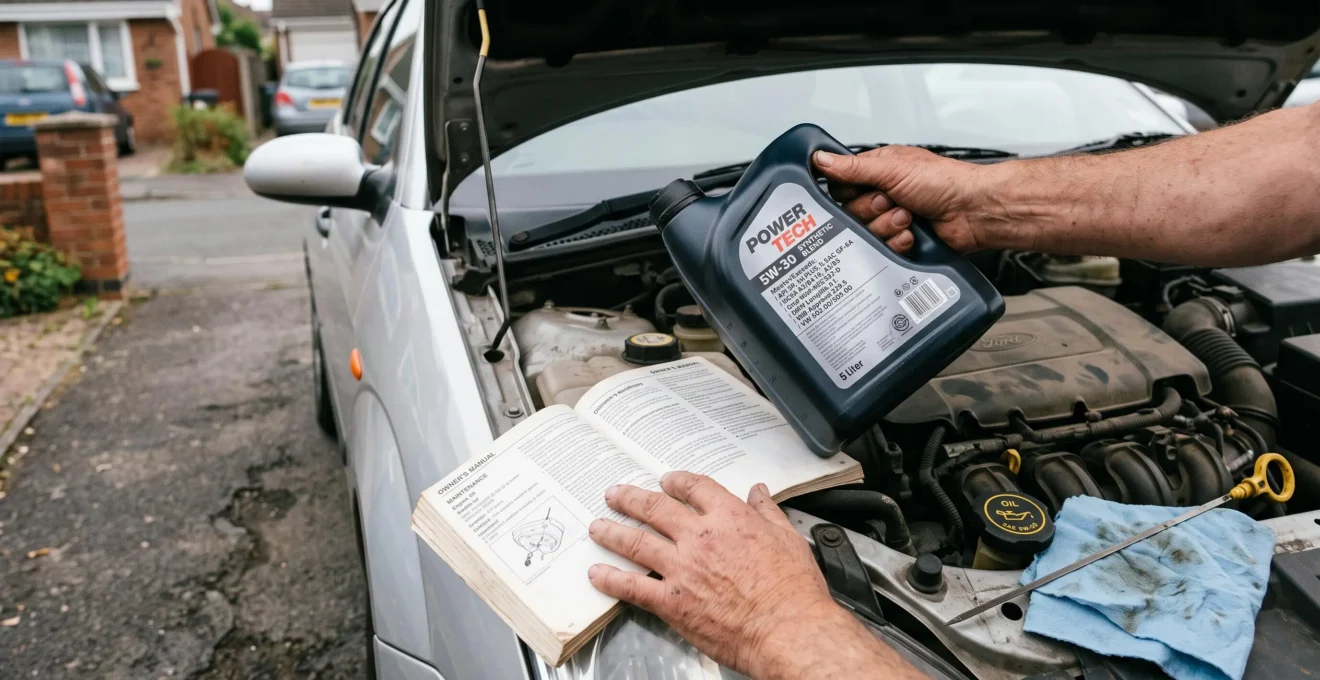
Two bottles of engine oil can display the same 5W-30 viscosity grade yet have different performance specifications, additive formulations and manufacturer approvals. One may be suitable for your engine, while the other may not satisfy its lubrication or emissions-system requirements.
Choosing the correct engine oil therefore involves more than selecting a familiar brand or deciding whether a thicker oil offers better protection. The essential information comes from your vehicle’s owner’s manual: the permitted SAE viscosity grade, the required oil performance standard and any manufacturer-specific approval.
These requirements matter during cold starts, sustained motorway driving, turbocharger operation and everyday journeys in traffic. They also influence which oils can be mixed during a top-up and how frequently the lubricant should be replaced.
The safest purchasing approach is to identify your engine’s exact requirements first, verify them against the product label or technical data sheet, and maintain those specifications throughout the vehicle’s service life.
Engine oil specifications: the essentials
- Match viscosity and performance approval. An SAE grade such as 0W-20 or 5W-30 does not establish that an oil meets your engine manufacturer’s requirements.
- Choose performance over marketing. Fully synthetic oil offers advantages in demanding conditions, but the correct specification matters more than the synthetic label.
- Adapt maintenance to actual driving. Short journeys, repeated cold starts and prolonged idling may justify shorter oil-change intervals when the manufacturer’s schedule identifies them as severe service.
- Why Does Engine Oil Viscosity Matter During Cold Starts?
- How to Find the Correct Oil Approval in Your Owner’s Manual?
- Fully Synthetic or Semi-Synthetic Oil: Which Meets Your Engine’s Needs?
- What Can Go Wrong When You Top Up with the Wrong Engine Oil?
- When Does Stop-Start Driving Require More Frequent Oil Changes?
- Manufacturer Service Schedule or Garage Advice: Which Should You Follow?
- Why Does the Order of Maintenance Tasks Matter During a Car Service?
- How to Build a Regular Car Maintenance Routine That Prevents Breakdowns
Why Does Engine Oil Viscosity Matter During Cold Starts?
Engine oil viscosity matters during cold starts because oil becomes more resistant to flowing as temperatures fall. The correct winter viscosity helps the engine crank and allows its lubrication system to supply critical components promptly. Choosing an unsuitable grade can increase cold-start lubrication difficulties, even when the oil performs adequately at normal operating temperature.
When an engine has been switched off, much of its oil drains back into the sump, although a protective film remains on lubricated surfaces. During the next start, the oil pump must re-establish circulation while bearings, valve-train components and other moving parts begin operating.
Cold oil is more viscous than warm oil. Poor cold-temperature performance can increase pumping resistance and delay the establishment of adequate lubrication in parts of the engine. This makes the first moments of operation particularly important for controlling wear.
The first number in a multigrade oil designation indicates its winter-temperature performance. In 0W-20, for example, the 0W classification describes specified low-temperature cranking and pumping characteristics, while the 20 classification describes viscosity characteristics at elevated temperatures.
Cranking and pumping performance are related but distinct properties. Cranking viscosity describes resistance under conditions relevant to starting the engine. Low-temperature pumping requirements help establish whether the oil can be delivered through the lubrication system under specified cold conditions. Easy engine starting alone does not prove that oil circulation is adequate.
The following comparison explains how to interpret common SAE grades. It is a reading guide, not a substitute for the viscosity range permitted by your vehicle manufacturer.
| SAE grade | Cold-temperature classification | Operating-temperature classification | Selection consideration |
|---|---|---|---|
| 0W-20 | 0W: more demanding low-temperature requirements than 5W or 10W | SAE 20 | Use where the manufacturer specifies or permits SAE 20 with 0W winter performance. |
| 5W-30 | 5W: less demanding low-temperature requirements than 0W | SAE 30 | Common in various engines, but the exact performance approval must also match. |
| 10W-40 | 10W: less demanding low-temperature requirements than 0W or 5W | SAE 40 | Appropriate only where the engine manufacturer permits this grade. |
Start with the manufacturer’s permitted grades, then consider the coldest temperatures at which the car will be started. The second number must also remain within the manufacturer’s requirements. A higher hot-viscosity grade is not automatically more protective: excessive viscosity can alter oil flow, pumping losses and engine operation.
Modified engines and engines with substantial wear sometimes require individual assessment. A specialist may recommend a different grade after examining operating clearances, oil pressure, usage and manufacturer guidance. High mileage by itself does not establish that thicker oil is necessary.
The API Motor Oil Guide distinguishes SAE viscosity grades from API and ILSAC performance classifications and recommends following vehicle-manufacturer oil requirements.
Viscosity is the first essential filter, but it cannot tell you whether an oil’s additives and performance characteristics satisfy your engine’s approval requirements.
How to Find the Correct Oil Approval in Your Owner’s Manual?
To find the correct engine oil approval, consult the lubricants, technical specifications or maintenance section of your owner’s manual. Identify both the permitted SAE viscosity grade and the required performance standard or manufacturer approval. The exact approval is essential because oils of identical viscosity can offer different protection for engines and emissions-control systems.
Most manuals identify oil requirements through a combination of viscosity and technical standards. Depending on the vehicle, these may include API categories, ACEA specifications, ILSAC classifications or manufacturer-specific approval codes.
These classification systems serve different purposes:
- SAE viscosity identifies the oil’s viscosity classification, including winter and high-temperature characteristics.
- API and ILSAC classifications identify defined engine oil performance requirements, particularly relevant to North American petrol-engine applications.
- ACEA specifications describe European engine oil performance categories, including requirements relevant to certain exhaust aftertreatment systems.
- Manufacturer approvals identify additional requirements established by vehicle manufacturers, including Volkswagen, Mercedes-Benz and BMW.
For example, a manual might specify SAE 5W-30 together with a particular manufacturer approval code. Another SAE 5W-30 bottle without that approval should not automatically be treated as equivalent.
The wording on the product label also matters. An oil described as « recommended for », « suitable for » or « meets the requirements of » a particular specification may be making a manufacturer or supplier performance claim rather than confirming formal approval by the vehicle manufacturer.
Where formal approval is required, look for the precise approval code on the bottle and technical product data sheet. If necessary, check the vehicle manufacturer’s published approval list or request confirmation from an authorised dealer or lubricant supplier.
Older manuals sometimes name specifications that have subsequently been replaced. For example, API SQ and ILSAC GF-7 were introduced in March 2025. Newer API gasoline-engine categories generally incorporate performance requirements from earlier categories for applications covered by API’s backward-compatibility guidance. However, API category compatibility does not establish compatibility between every manufacturer-specific approval.
Likewise, when a manual lists several viscosities, its temperature conditions and associated approval requirements must be considered together. A broad list of SAE grades does not necessarily mean that every grade is suitable in every climate or service condition.
Five checks before buying engine oil
- Identify your exact vehicle, engine variant and model year. Record them alongside the manual edition or vehicle identification details.
- Find the lubrication specifications in the owner’s manual. Write down every permitted SAE grade and any temperature restrictions.
- Copy the required API, ACEA, ILSAC or manufacturer approval code exactly into a purchase note.
- Compare the bottle label and current product data sheet against that note. Save the product name, viscosity and documented approval status.
- If an approval is unclear or obsolete, request written clarification from an authorised dealership or oil manufacturer before purchasing. Retain the confirmation with your service records.
Keep the final product details on your phone or in the vehicle’s maintenance records. This makes future top-ups easier and provides evidence of the lubricant specification used during servicing.
Once the required approval and grade have been established, the next decision is whether the engine benefits from fully synthetic oil or whether an approved semi-synthetic formulation is sufficient.
Fully Synthetic or Semi-Synthetic Oil: Which Meets Your Engine’s Needs?
Fully synthetic oil is generally preferable when an engine requires demanding thermal stability, low-temperature performance or extended service capability. Semi-synthetic oil can be suitable for less demanding applications when it satisfies the required specification. The deciding factor is not the marketing label but whether the finished oil meets your engine’s viscosity and approval requirements.
Engine oils contain base oils and carefully balanced additive packages. Base oils influence properties such as volatility, viscosity behaviour and oxidation resistance, while additives control wear, deposits, corrosion and contamination.
Fully synthetic formulations typically provide more formulation flexibility and can deliver strong performance across demanding temperature conditions. However, the terms « fully synthetic » and « semi-synthetic » do not themselves define a universal, independently comparable level of engine protection.
What counts as synthetic can also depend on regional terminology and product classification practices. Two oils sold under similar descriptions may have significantly different performance characteristics.
For buying decisions, the following comparison is more useful than treating synthetic content as an automatic quality ranking.
| Engine or driving condition | Fully synthetic oil | Semi-synthetic oil |
|---|---|---|
| Modern turbocharged engine | Often favoured for demanding thermal and performance requirements. | Only suitable where the exact manufacturer specification permits it. |
| Older, relatively simple engine | Can be suitable when approved, but may offer limited practical benefit for gentle use. | May offer adequate performance and lower purchase cost when specified. |
| Very cold starts | Often provides formulation advantages for low-temperature operation. | Acceptable only when the required winter grade and performance standards are met. |
| Extended oil-change intervals | Commonly used in formulations designed for demanding manufacturer service requirements. | Must not be assumed suitable without the required approval. |
| Diesel engine with particulate filter | Suitable where the formulation carries the appropriate emissions-system specification. | Also depends on the required low- or controlled-SAPS specification, not simply base-oil type. |
The financial comparison should consider more than the price per litre. Oil cost is only one component of servicing, alongside the filter, labour and replacement frequency. A more expensive lubricant may be justified by its required approval or performance characteristics, but not merely by a claim that it can remain in service longer.
Switching to fully synthetic oil does not automatically extend your oil-change interval. Follow the manufacturer’s schedule and the requirements of any oil-life monitoring system. A product advertised for extended drainage is not permission to exceed your vehicle’s limits.
Changing between synthetic and semi-synthetic oils does not normally require a special flushing procedure solely because of their base-oil categories. Any additional cleaning or repair should be based on a genuine mechanical concern or manufacturer instruction.
For a top-up, physical miscibility is not the same as specification compatibility. Different oil types may mix, but the combined oil is not automatically guaranteed to retain the required manufacturer approval. Where possible, use the same approved product already in the engine.
Even a carefully selected oil can create uncertainty when it is mixed with another formulation. Understanding what happens during an incorrect top-up helps determine whether immediate action is necessary.
What Can Go Wrong When You Top Up with the Wrong Engine Oil?
Adding the wrong engine oil can affect lubrication behaviour, additive performance and compatibility with emissions-control equipment. The risk depends on the amount added, how different the specifications are and how the vehicle is subsequently driven. A small addition of a compatible oil is different from filling the entire engine with a product that lacks the required approval.
Engine oils are formulated around specific viscosity and performance targets. Mixing them does not necessarily produce immediate damage, but it can alter the final mixture’s properties in ways that are difficult to establish without testing.
A minor emergency top-up with an oil of similar specifications may present less risk than a complete refill with an unsuitable lubricant. However, there is no universal quantity that makes every mismatch harmless.
Different specification errors create different concerns:
- Incorrect viscosity: an oil substantially outside the required SAE grade can alter cold-start pumping, operating-temperature film characteristics and oil-pressure behaviour.
- Incorrect SAPS characteristics: replacing an oil requiring controlled sulphated ash, phosphorus and sulphur levels with a high-SAPS formulation can increase long-term risks to particulate filters or other emissions-control components.
- Diesel-oriented oil in a petrol engine: an oil intended primarily for diesel service may lack required petrol-engine performance characteristics unless it also carries the applicable petrol approvals.
- Incorrect manufacturer approval: a lubricant can have a suitable viscosity yet lack the required performance in areas such as wear control, deposits or emissions-system compatibility.
These are potential mechanisms, not proof that every incorrect top-up immediately causes damage. Some oils carry multiple petrol and diesel specifications, and some formulations are explicitly approved for several engine families.
After discovering an incorrect top-up, establish the amount added and identify the exact product. Compare the label against the required specification and note whether the vehicle has been driven since the addition.
| Situation | Initial assessment | Recommended response |
|---|---|---|
| Small addition of oil with matching grade and required approval | Normally a lower-concern situation, subject to product compatibility. | Verify the specifications and monitor the oil level as instructed by the manufacturer. |
| Small addition with an uncertain or different approval | Risk cannot be judged from quantity alone. | Identify both products and ask a qualified professional whether replacement is necessary. |
| Full refill with clearly incorrect viscosity or approval | Potentially significant specification mismatch. | Avoid unnecessary driving and arrange professional assessment and corrective servicing. |
| Oil-pressure warning, abnormal mechanical noise or suspected overfill | Possible immediate lubrication or engine-damage risk. | Stop safely, switch off the engine and seek professional assistance. |
Repeatedly topping up with different, unverified oils creates a further problem: the additive composition of the sump oil becomes increasingly uncertain. Even where individual products are technically miscible, repeated mixing can change the effective additive balance and compromise confidence in the required performance specification.
Do not assume that bringing the next scheduled oil change forward by an arbitrary distance will resolve every error. A serious mismatch may justify replacement before further use, whereas a minor verified-compatible addition may require no special intervention.
The best prevention is straightforward: retain a clearly identified supply of the correct approved oil and monitor consumption. Oil replacement timing then becomes the next important factor in maintaining lubrication quality.
When Does Stop-Start Driving Require More Frequent Oil Changes?
Frequent short journeys, repeated cold starts and prolonged idling can justify shorter oil-change intervals when the manufacturer’s severe-service schedule applies. These conditions can accelerate contamination and oil deterioration, particularly when the engine rarely reaches full operating temperature. Factory automatic stop-start systems alone do not establish that more frequent changes are necessary.
Oil deteriorates through several mechanisms, including oxidation, contamination, additive depletion and dilution by fuel. The rate depends on engine design, lubricant formulation and how the vehicle is used.
During short trips, the engine may run for much of the journey below normal operating temperature. Fuel and moisture entering the oil may not be removed as effectively as they are during sustained operation at appropriate temperatures.
Long periods of idling can also accumulate operating hours without adding much distance to the odometer. A vehicle used mainly in congestion can therefore experience considerable engine running time while covering relatively few miles or kilometres.
To assess your driving, compare your actual pattern with the normal and severe operating conditions in the vehicle’s maintenance schedule. Indicators worth checking include:
- Repeated journeys ending before the engine has fully warmed up.
- Regular extended idling or prolonged low-speed traffic.
- Frequent towing, heavy loading or demanding operating conditions.
- Repeated operation in particularly cold or hot environments.
- Low annual mileage combined with long periods between services.
Some vehicles use an electronic oil-life monitoring system rather than relying solely on a fixed distance. These systems estimate oil life using operating data and manufacturer-defined calculations; they are not necessarily direct laboratory measurements of the oil’s chemical condition.
For example, Ford’s scheduled maintenance instructions describe an Intelligent Oil Life Monitor that adjusts oil-change timing according to vehicle operation. The documented vehicle also has a maximum time or distance limit.
5,000–7,500 miles
Approximately 8,000–12,000 km: an illustrative severe-use oil-change interval in the cited Ford maintenance documentation. It applies to the documented vehicle and must not be adopted as a universal interval.
Ford Motor Company, Scheduled Maintenance — manufacturer owner’s manual documentation.
If your car displays an oil-change-required message, follow its model-specific instructions, including any deadline for servicing. Also observe the maximum time limit in the manual, even if the mileage threshold has not been reached.
For cars driven almost exclusively on very short urban journeys, low annual mileage should not be mistaken for low maintenance demand. Time-based limits remain relevant because contamination, ageing and operating conditions are not represented by distance alone.
Once the appropriate interval is identified, the remaining question is how to handle advice from a garage that differs from the manufacturer’s published schedule.
Manufacturer Service Schedule or Garage Advice: Which Should You Follow?
The manufacturer’s service schedule should be the starting point for deciding when engine oil and other maintenance items require attention. Garage advice can justify earlier servicing when it reflects the vehicle’s condition, usage or documented history. Recommendations that go beyond the official schedule deserve a clear explanation rather than automatic acceptance or dismissal.
Vehicle manufacturers establish service requirements around engine design, approved lubricants, expected operating conditions and maintenance procedures. Their schedules commonly distinguish normal use from severe or demanding operation.
A garage may identify circumstances that the owner has overlooked, such as recurring fuel dilution, unusual oil consumption, contamination or a maintenance history that does not match the recorded mileage.
In such cases, an earlier oil change may be reasonable. The recommendation should nevertheless be based on specific evidence or applicable manufacturer guidance, not solely on a universal mileage rule.
The FTC’s Auto Repair Basics consumer guidance recommends following the maintenance schedule for the vehicle’s type of driving and questioning additional maintenance recommendations where their necessity is unclear.
« Follow the manufacturer’s maintenance schedule in your owner’s manual for your type of driving. »
When a garage suggests an oil change earlier than the published interval, ask which specific part of the manufacturer’s schedule supports its recommendation. Also establish whether the advice results from the actual driving conditions, an inspection finding or a known issue affecting the vehicle.
A recommendation to halve every oil-change interval, regardless of engine, usage and oil specification, should be questioned. That does not mean every shorter interval is unjustified: the relevant operating conditions and technical evidence determine whether additional servicing is beneficial.
Service documentation matters for future repairs, warranty disputes and resale. Retain invoices showing the work performed, mileage, service date and the oil specification used. Written records help demonstrate that maintenance followed the applicable requirements.
Warranty rights vary between countries, manufacturers and circumstances. Servicing outside a franchised dealership does not automatically invalidate every warranty, but incorrect materials or maintenance procedures can become relevant to a particular claim. Check the terms applicable to your vehicle and jurisdiction.
Where manufacturer guidance and garage advice differ, request an explanation before authorising additional work. For significant or expensive recommendations, a second professional opinion may be appropriate.
A well-supported service recommendation should lead to work that is carried out correctly. That includes using an appropriate sequence of maintenance tasks, particularly during an oil and filter change.
Why Does the Order of Maintenance Tasks Matter During a Car Service?
The order of maintenance tasks matters because some operations depend on earlier checks or replacements being completed correctly. During an oil service, the old lubricant must be drained, the relevant filter replaced and the correct quantity of approved oil added using the manufacturer’s procedure. Logical sequencing also helps prevent contamination, inaccurate fluid readings and missed problems.
A professional service begins with the manufacturer’s instructions and a vehicle-specific assessment. The workshop may need to identify existing leaks, warning messages, fluid levels and other conditions before removing or replacing components.
Engine oil is often drained after the engine has been warmed, because warmer oil generally flows more readily. However, safe handling temperatures, drain procedures and equipment requirements must follow the vehicle manufacturer’s instructions.
For a conventional engine oil and filter change, the logical sequence generally includes:
- Confirm the required oil specification, quantity, filter type and vehicle-specific service procedure.
- Position and secure the vehicle correctly, then drain the old engine oil using the prescribed method.
- Remove and replace the oil filter, following the required installation, sealing and tightening instructions.
- Close the drain point correctly and refill with the specified lubricant, observing the manufacturer’s filling and priming requirements where applicable.
- Run the engine according to the service procedure, check for leaks and verify the oil level after the specified settling period.
- Complete any required oil-life monitor reset and record the service details.
Some engines require additional measures, including particular filter-housing procedures, electronic level measurements or oil-system priming. These instructions take precedence over a generic service sequence.
Other maintenance operations also benefit from careful ordering. Brake inspections may be coordinated with wheel removal, fluid checks may require level ground or particular temperatures, and leak assessments are more meaningful when surfaces and surrounding components can be inspected before and after work.
Good sequencing creates opportunities for cross-checks. During an oil change, a technician may discover a deteriorated seal, damaged undertray, loose connection or evidence of a fluid leak that warrants attention.
The service invoice should identify the actual operations performed, rather than merely use a broad label such as « full service ». Confirm that the oil grade, approval and filter details are consistent with your vehicle’s requirements.
An invoice’s line-item order does not necessarily reflect the chronological workshop procedure. If something is unclear, ask how the relevant task was performed and whether the required post-service checks were completed.
Professional servicing addresses scheduled work, but routine checks between visits are equally important for identifying developing problems before they lead to avoidable repairs or breakdowns.
Key takeaways for ongoing maintenance
- Turn the manufacturer’s service schedule into a personal calendar based on both time and distance, adjusted for actual driving conditions.
- Keep a reliable record of oil level changes, top-ups and servicing to distinguish occasional observations from developing trends.
- Prioritise checks that can reveal immediate safety or mechanical risks, rather than relying solely on the date of the next booked service.
How to Build a Regular Car Maintenance Routine That Prevents Breakdowns
A preventive car maintenance routine combines scheduled professional servicing with regular owner-level inspections. Use the manufacturer’s time and mileage requirements as the foundation, then check oil level, coolant, tyres, lights and battery condition between services. Recording changes and using the correct approved fluids helps identify problems early and reduces the risk of preventable failures.
Begin with the vehicle’s official maintenance schedule. Transfer its service dates, mileage limits and inspection requirements into a calendar or maintenance log. Where both time and distance limits apply, arrange maintenance when the first applicable limit is reached.
Distinguish tasks suitable for routine owner checks from work that requires professional equipment or technical competence. Checking an accessible dipstick is different from inspecting brake hydraulics, working beneath a vehicle or investigating an oil-pressure fault.
A practical routine can be organised around monthly checks, longer-term service reminders and immediate responses to warning signs.
| When to check | Maintenance item | What to verify |
|---|---|---|
| Monthly and before demanding journeys | Engine oil | Correct level using the manufacturer’s specified checking procedure; investigate unexpected consumption. |
| Monthly, when the engine is cold | Coolant | Level within the marked range where the reservoir is designed for owner inspection; watch for unexplained loss. |
| Monthly and before long trips | Tyres | Inflation pressure, visible damage and tread condition. |
| Regularly | Lights and warning indicators | Correct operation and any unresolved dashboard alerts. |
| According to symptoms and the service schedule | Battery and charging system | Starting performance, warning indicators and professional testing where appropriate. |
| Manufacturer-specified interval | Oil, filters and other scheduled components | Professional servicing using the required procedures, specifications and replacement intervals. |
A useful monthly engine-bay inspection need not be complicated. Park on level ground, secure the vehicle and follow the manual’s instructions for checking oil. Some engines require a cold reading, while others specify checking after the engine has reached operating temperature and then rested for a defined period.
For vehicles fitted with a dipstick, remove and wipe it, reinsert it fully and read the level as directed by the manufacturer. Vehicles using electronic level measurement require their specified dashboard or diagnostic procedure instead.
Inspect the coolant level only under the prescribed safe conditions, generally with the engine cold. Never open a pressurised cooling-system cap while hot. A repeatedly falling coolant level warrants investigation rather than continued topping-up without diagnosis.
Keep the correct approved top-up oil securely stored and clearly identified, preferably in its original sealed or properly closed container. Record the quantity and date whenever oil is added. A trend of increasing consumption can be more informative than one isolated reading.
When maintenance time or budget is limited, concentrate first on issues with potentially serious consequences. Low engine oil or oil-pressure warnings can threaten the engine. Coolant loss may lead to overheating, tyre defects can compromise road safety, and battery or charging-system problems can leave a vehicle unable to start.
Maintenance records should also capture unusual noises, warning messages, fluid leaks and changes in starting behaviour. Do not wait for the next scheduled service when a symptom indicates an immediate safety or mechanical concern.
Start by recording your next oil-change deadline, the exact approved oil specification and your latest oil-level reading. These three details establish a practical baseline for consistent maintenance and more informed decisions at the next service.
Can two engine oils with the same viscosity have different manufacturer approvals?
Yes. SAE viscosity describes defined flow characteristics, not the oil’s complete performance specification. Two 5W-30 oils may have different additive systems, emissions-equipment compatibility and manufacturer approvals. Always check the exact performance code required by your engine.
Is the latest API oil category suitable for every older engine?
No. Newer API gasoline-engine categories generally provide backward compatibility for applications covered by API’s guidance, but this does not override individual manufacturer approvals, viscosity restrictions or special engine requirements. Diesel categories also have compatibility exceptions, including API FA-4. Check the specific vehicle documentation before substituting a newer category.
Does a low-SAPS engine oil automatically suit every car with a particulate filter?
No. Low- or controlled-SAPS characteristics may be important for particulate-filter compatibility, but they are not sufficient on their own. Different engines require different viscosity grades, performance categories and manufacturer approvals. An oil designed for one particulate-filter-equipped engine may not be approved for another.
Can changing oil brands affect engine protection?
Changing brands is generally less important than maintaining the correct viscosity and performance specifications. When both products have the required approvals, a change of brand does not inherently imply reduced protection. For mixing or topping up, however, use the same approved product wherever possible, because compatibility of separate formulations cannot be assumed from brand-independent claims alone.
Should engine oil be changed immediately when it looks dark?
Not necessarily. Oil colour alone is not a reliable measure of remaining service life, particularly in diesel engines where oil can darken relatively quickly. Follow the applicable maintenance schedule or oil-life monitor. Unexpected contamination, abnormal oil appearance accompanied by symptoms, or a rising oil level should be assessed professionally rather than judged by colour alone.