
Finding the right replacement car part requires more than entering a make, model and year into an online catalogue. Two vehicles sold under the same model name can use different brake systems, electrical connectors, engine components or suspension assemblies. A replacement that looks correct in a product photograph may still be incompatible with the vehicle parked outside.
The most reliable approach is to identify the vehicle precisely, establish the correct original equipment manufacturer (OEM) part number and verify the proposed replacement against relevant fitment data. The vehicle identification number (VIN), engine code, production date and existing component markings can all help resolve uncertainty.
These checks matter particularly when purchasing expensive electronics, braking components or parts affected by mid-production changes. A few additional verification steps can prevent unnecessary returns, installation delays and potentially unsafe substitutions.
The objective is straightforward: establish which component the vehicle actually requires, confirm that the seller supplies that specification and check the installation requirements before placing an order.
Car part compatibility: the essential checks
- Identify the exact vehicle: use its VIN, engine specification, production information and relevant optional equipment rather than relying on model year alone.
- Verify the component reference: cross-check the OEM number, manufacturer-approved supersessions and aftermarket fitment restrictions before ordering.
- Resolve uncertainty before installation: compare connector types, dimensions, mounting details and required calibration procedures, especially for safety-critical parts.
- Why Do Identical-Looking Car Parts Have Different Fitment Requirements?
- How to Match OEM Part Numbers to Your Vehicle Before Ordering Online
- VIN Lookup or Registration Search: Which Gives More Accurate Parts Results?
- The Mid-Production Changes That Can Make a Replacement Part Incompatible
- What to Do When Two Parts Catalogues Recommend Different Components
- Why Oversized Off-Road Parts Can Create Problems on Road Cars
- When Should You Replace Worn Car Parts Instead of Repairing Them?
- What Should You Verify After Installing a Replacement Car Part?
Why Do Identical-Looking Car Parts Have Different Fitment Requirements?
Identical-looking car parts can have different fitment requirements because manufacturers use different components across engine configurations, trim levels, production periods and regional markets. Differences in electrical connectors, mounting points, internal specifications or software can make apparently interchangeable parts incompatible. Physical resemblance is not proof of compatibility; the correct match depends on vehicle-specific technical data.
Modern vehicle platforms commonly support several powertrains and equipment packages. A component may share its exterior housing with another version while containing different electronics, mechanical internals or control settings.
Consider two brake pad sets designed for calipers that appear identical. Their dimensions may match, yet the friction material, wear sensor arrangement or approved application may differ. A similar issue arises with headlights: two assemblies can share the same front profile while using different connectors, lighting technology or beam-leveling equipment.
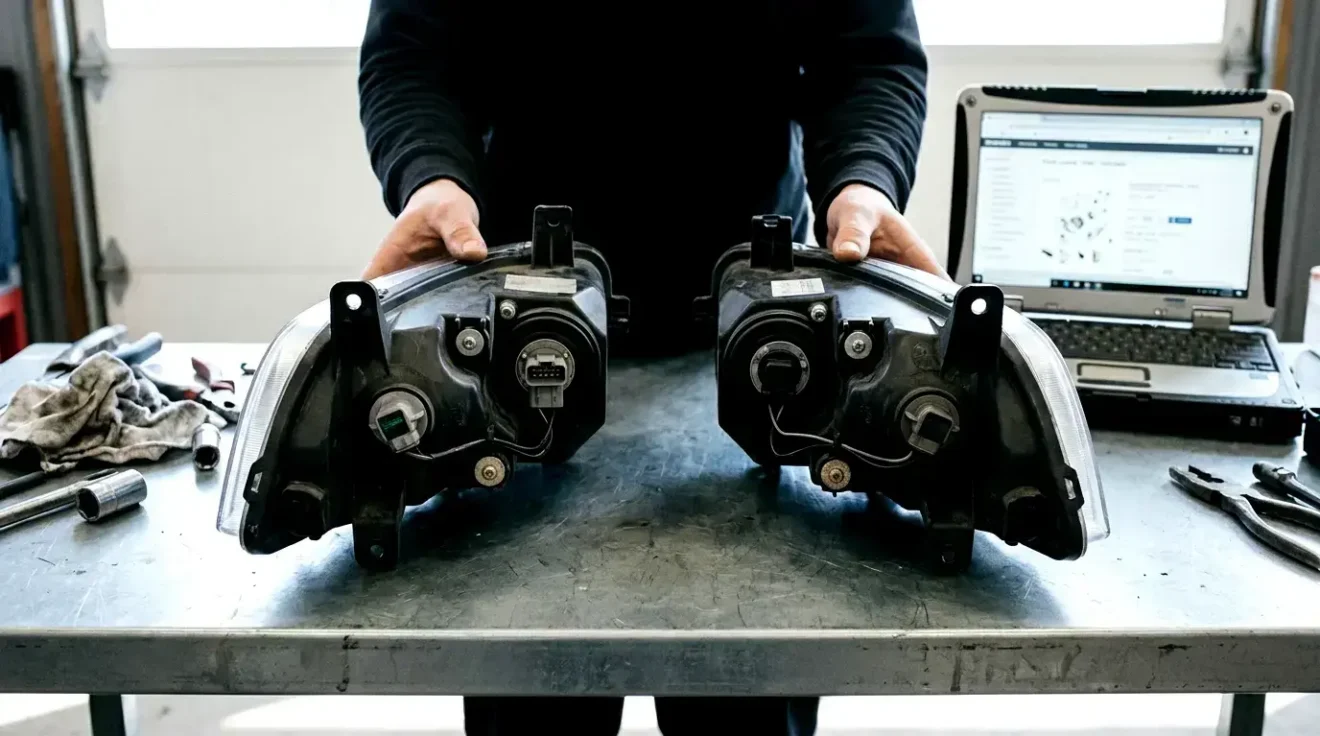
The distinction between a functionally equivalent replacement and a vehicle-specific component is important. An aftermarket supplier may manufacture one replacement compatible with several original references. That shared application is acceptable when the supplier has verified all relevant specifications and documented any restrictions.
Conversely, an OEM catalogue may list separate original parts for configurations that a qualified aftermarket supplier covers with one replacement. This difference in catalogue structure can explain why sellers display different numbers without necessarily indicating an error.
Before accepting a product listing, examine its fitment notes for engine code, production date, equipment restrictions and installation position. A listing that only mentions the vehicle model is incomplete evidence when several variants exist.
Once the precise technical specification is established, the next step is to connect it to a traceable manufacturer part reference.
How to Match OEM Part Numbers to Your Vehicle Before Ordering Online
To match an OEM part number to your vehicle, first identify the component in a manufacturer parts diagram, then compare its reference with the number on the existing part and confirm the application using the vehicle’s VIN. Check for manufacturer-approved replacement numbers, production restrictions and required quantities before choosing an aftermarket equivalent.
An OEM part number is a reference assigned within the vehicle manufacturer’s parts system. It provides a more precise starting point than a product description such as « front brake disc » or « replacement alternator ». However, the number must still be checked against the correct vehicle configuration.
A practical identification process follows three stages:
- Locate the component: select the correct vehicle in an OEM catalogue and identify the assembly using its exploded parts diagram. Check whether the drawing distinguishes left and right, front and rear, or separate equipment variants.
- Inspect the original part: where safe and accessible, record the stamped, engraved or printed reference. Distinguish the actual part number from casting numbers, supplier codes and production markings.
- Verify the application: compare the number against VIN-filtered manufacturer information and confirm whether a newer approved service reference replaces it.
For example, Toyota’s official vehicle and parts catalogue supports vehicle identification and searches by part number or VIN for US-market vehicles. It illustrates how vehicle-specific selection reduces ambiguity before browsing replacement components.
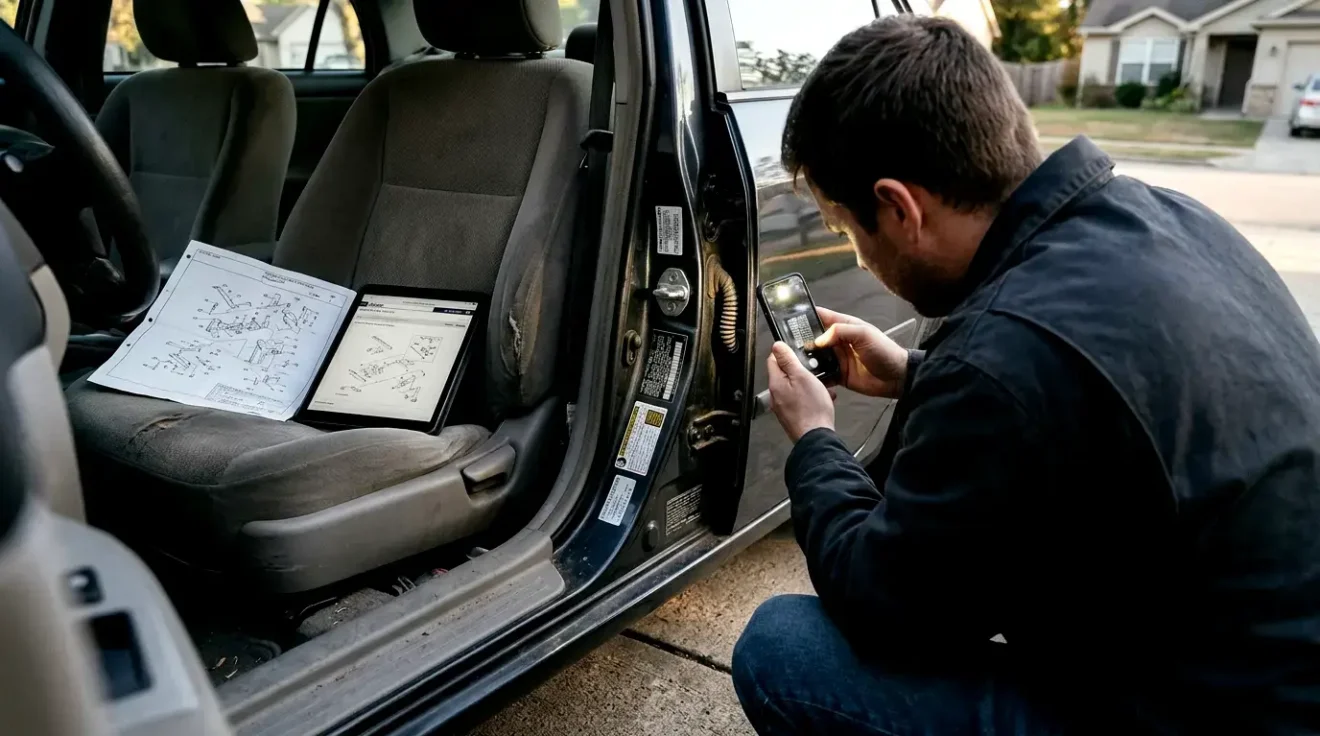
Part-number supersession introduces another complication. Manufacturers sometimes replace an original reference with a revised service part. An older number can remain useful for identification without being the correct number to order today.
Manufacturer example: Subaru part-number supersession
In Subaru’s technical service bulletin on telematics module replacement, dated February 18, 2022, replacement reference 86229AL10B is associated with earlier references including 86229AL00A, 86229AL00B and 86229AL00C.
For the vehicles covered by that bulletin, Subaru instructs technicians to check its electronic parts catalogue using the VIN and verify current supersession information. It also warns against installing the superseded modules in that procedure. The example demonstrates why matching an old number is insufficient without confirming the approved replacement.
Aftermarket identifiers require similar care. A supplier’s reference may cross-reference several OEM numbers, while a retailer’s stock keeping unit (SKU) is simply its internal inventory identifier. Neither establishes compatibility independently.
Five checks to complete before ordering a replacement part
- Record the VIN and relevant engine or equipment details. Deliverable: a saved vehicle specification record.
- Identify the component in the appropriate parts diagram. Deliverable: its exact location and installation position.
- Compare the existing component reference with the catalogue. Deliverable: a confirmed OEM number or documented discrepancy.
- Verify the approved replacement reference and quantity required per vehicle. Deliverable: a matched part listing with its application restrictions.
- Read the seller’s return conditions, including exclusions for fitted electrical items. Deliverable: a saved copy of the applicable return policy.
Even a confirmed reference should be evaluated against the vehicle identification method used by the seller, particularly when multiple versions of the same model exist.
VIN Lookup or Registration Search: Which Gives More Accurate Parts Results?
A manufacturer-supported VIN lookup is generally the stronger starting point for identifying vehicle-specific replacement parts, while registration searches are convenient for quickly finding a model. A VIN identifies an individual vehicle, but accurate parts selection still depends on the catalogue’s build records and equipment coverage. Neither method eliminates the need for additional checks when fitment information is incomplete.
A registration number search retrieves vehicle information associated with a number plate in an available registration database. Depending on the country and provider, it may identify the make, model, engine variant and registration details. Registration records do not necessarily describe every factory-installed option.
A VIN is the vehicle’s unique identification reference. For modern vehicles using the standard 17-character format, it provides a basis for accessing manufacturer-specific vehicle records.
However, an important distinction applies: decoding the VIN alone is not the same as retrieving the complete factory build specification. A basic public decoder may identify general vehicle characteristics, whereas an OEM system linked to production records may provide more detailed configuration information.
The following comparison explains how to use each method without overstating its capabilities.
| Criterion | VIN lookup | Registration search |
|---|---|---|
| Starting information | Vehicle identification number | Registration plate |
| Typical advantage | Identifies the individual vehicle | Quick and convenient model identification |
| Equipment detail | May access exact build data through OEM records | Depends on registration database coverage |
| Production variations | Can support chassis-specific parts filtering | May not resolve production break points |
| Main limitation | Decoder or catalogue information may be incomplete | Registered model details may omit relevant options |
| Best practical use | Confirming specific replacement applications | Generating an initial vehicle shortlist |
VIN-based results deserve particular scrutiny for imports, vehicles built for another regional market, recently introduced models and vehicles modified after manufacture. An imported vehicle may not be fully covered by the catalogue intended for its current country.
For components with several possible specifications, use a practical hierarchy: registration for initial identification, VIN for detailed confirmation and physical inspection to resolve discrepancies.
If a vehicle has received a replacement engine, retrofit lighting or a modified braking system, its original production record may no longer describe the installed assembly accurately. In that situation, compare the existing part’s verified markings and configuration with manufacturer-approved service information.
The next major source of uncertainty is production timing: even vehicles built within the same model year may require different components.
The Mid-Production Changes That Can Make a Replacement Part Incompatible
Manufacturers can revise vehicle components during an ongoing production run without changing the model name or advertised model year. These changes may involve suppliers, mounting arrangements, sensors, electronics or emissions equipment. As a result, a part listed for the correct year can still be incompatible unless its production-date or chassis-number restrictions match the individual vehicle.
A model year is a broad commercial designation, not always a precise manufacturing interval. A vehicle registered in one calendar year may have been built earlier, and parts changes can occur between production batches.
Manufacturers may introduce revisions to improve reliability, meet technical requirements, accommodate a new supplier or support updated equipment. Some changes become visible during a facelift; others remain hidden inside an otherwise unchanged model.
Common examples include:
- Alternators: changes in mounting brackets, electrical plugs, pulley arrangements or output specifications.
- Brake assemblies: different disc diameters, caliper applications or equipment packages associated with particular wheel and braking configurations.
- Sensors: revised connector designs, signal specifications or mounting arrangements.
- Headlights: changes in lighting technology, control modules and leveling equipment.
- Emissions components: revised sensors, exhaust assemblies or control hardware associated with specific engine and emissions configurations.
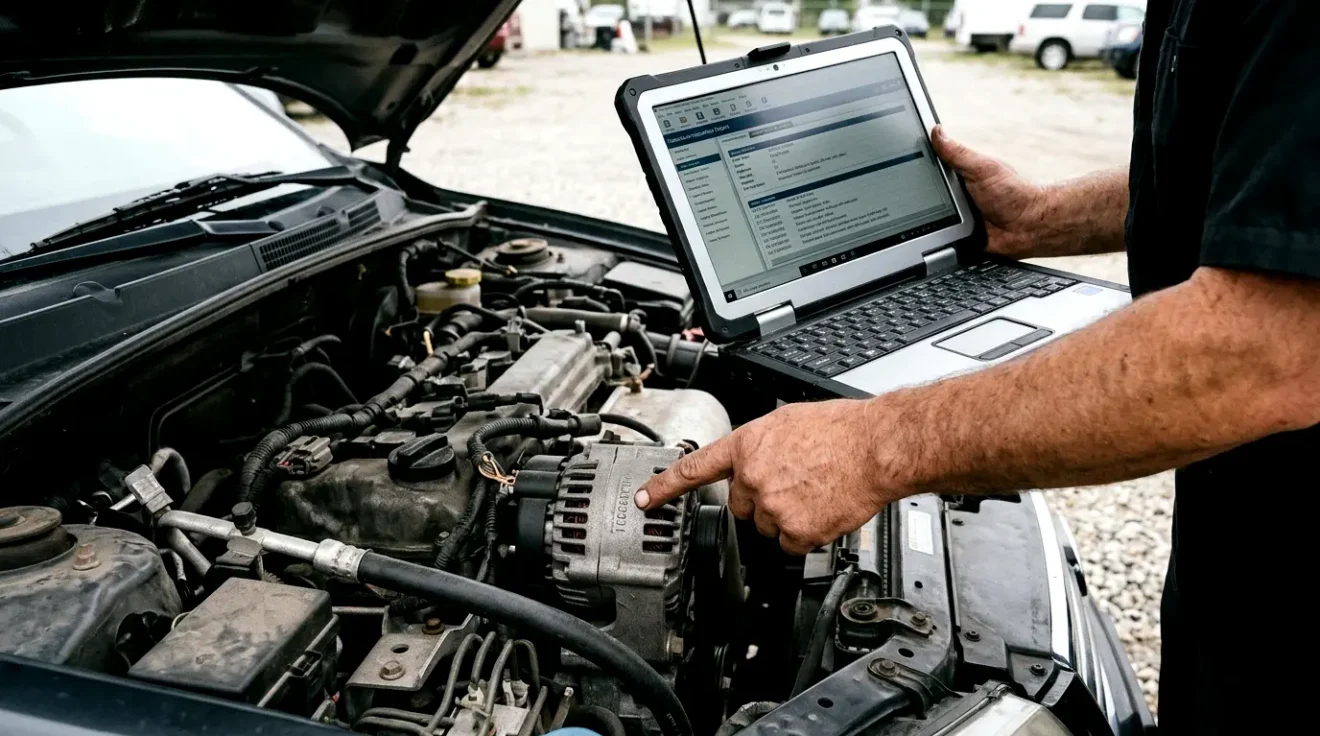
Parts catalogues usually express these differences through application restrictions. A listing might specify production « up to » or « from » a particular date, or show chassis-number ranges. Such notes are part of the fitment specification, not optional product information.
Consider a hypothetical vehicle manufactured during a year in which its alternator connector changed. A listing that only says the alternator fits that model year might return both versions. The buyer needs the applicable production break point and must verify which connector the vehicle actually uses.
Start by identifying the manufacturing information through the relevant manufacturer records or vehicle identification label. Next, compare the VIN or chassis sequence against the catalogue’s stated range. When the change involves a visible component characteristic, confirm the existing specification before ordering.
A casting number can provide useful identification evidence, but it should not automatically be treated as the complete service part number. One casting may be used in more than one finished assembly, so the manufacturer’s interpretation remains important.
When production information is unavailable or the vehicle has undergone previous repairs, a dealer parts department or qualified specialist may need to check the current assembly directly.
These restrictions also explain why apparently reputable catalogues sometimes disagree: their vehicle application records may not describe the same production variant.
What to Do When Two Parts Catalogues Recommend Different Components
When two parts catalogues recommend different components, first determine whether the references are approved replacements for the same original part or apply to different vehicle configurations. Compare the OEM references, production restrictions and equipment requirements. If the conflict remains, obtain manufacturer or dealer confirmation using the VIN before ordering expensive or safety-critical components.
Catalogue disagreements do not always mean that one seller is incorrect. Manufacturers and aftermarket suppliers may organize part references differently, and databases can reflect different update schedules, market coverage or product ranges.
A useful investigation starts with the component reference rather than the advertised product title.
- Compare OEM cross-references. Check whether both proposed parts explicitly reference the same genuine manufacturer number.
- Investigate supersession. Determine whether one reference has been officially replaced and whether the newer part is approved for the precise application.
- Check vehicle restrictions. Compare engine codes, production intervals, transmission types, equipment packages and regional specifications.
- Inspect the installed component. Where appropriate, verify the original reference, connector layout, mounting points and relevant dimensions.
- Escalate unresolved conflicts. Ask a manufacturer-authorized parts department to confirm the applicable service reference against the VIN and any known vehicle modifications.
The Subaru telematics bulletin discussed earlier demonstrates that supersession is not always straightforward interchangeability. Older numbers can remain identifiable while the manufacturer specifically requires a newer replacement for a particular repair procedure.
Commercial catalogue filters add another source of confusion. One website may display only the brands it stocks, while another lists several suppliers with overlapping fitment claims. Differences in available inventory should not be mistaken for differences in the vehicle’s technical requirements.
Risk should determine how much uncertainty is acceptable. The following comparison helps prioritize verification.
| Component category | Typical concern | Recommended response |
|---|---|---|
| Simple, low-cost non-safety consumables | Returns, wasted time or incorrect fit | Confirm basic specifications and return eligibility; do not force an uncertain fit |
| Alternators, starters and electronic modules | Connector differences, performance or coding requirements | Confirm OEM application, electrical specification and installation requirements |
| Brakes and steering components | Loss of safety-critical function | Resolve every relevant fitment conflict before ordering or installation |
| Airbag and restraint components | Incorrect deployment or system malfunction | Use manufacturer-approved identification and qualified professional procedures |
A generous return policy is useful protection against an ordering error, but it is not evidence that a component is technically suitable. This distinction matters for electrical parts that may be non-returnable after fitting and for components whose incorrect installation creates a safety risk.
For high-cost or safety-related purchases, keep a written record of the confirmed reference and any relevant application restrictions. Manufacturer confirmation should address the actual vehicle and service part, not merely the model name.
Fitment problems are not limited to conventional replacement parts. They become more complex when an accessory or modification deliberately changes the vehicle’s original specification.
Why Oversized Off-Road Parts Can Create Problems on Road Cars
Oversized off-road components can create problems on road cars because they change dimensions, suspension geometry, mass or mechanical loads beyond the vehicle’s original configuration. Larger tyres, suspension lifts and heavy-duty accessories may affect handling, braking, steering clearance and electronic systems. Their suitability depends on the complete modified vehicle, not simply whether the component can be physically installed.
Off-road upgrades are designed around particular operating conditions, but equipment appropriate for a modified trail vehicle is not automatically suitable for an ordinary road car.
Oversized tyres illustrate the interaction between components. Increasing overall rolling diameter can affect speedometer readings and the relationship between wheel rotation and distance travelled. Changes in tyre characteristics may also influence the behaviour of systems that use wheel-speed information.
The effects on ABS and stability-control performance depend on the vehicle’s control strategy, tyre sizes and modification details. A larger tyre does not automatically cause a specific electronic fault, but deviations from an approved configuration require technical assessment.
Other potential consequences include:
- Tyres rubbing against bodywork, steering components or suspension during turning and suspension travel.
- Additional loading on bearings, steering assemblies and suspension components, depending on wheel offset, mass and usage.
- Changes in steering response, vehicle balance and braking performance.
- Reduced clearance for brake components or wheel fixings when incompatible wheels are used.
- Altered vehicle height or load distribution when lift kits and heavy accessories are fitted.
Road legality must be checked separately from physical compatibility. Requirements vary between countries and sometimes between individual states, provinces or vehicle classes.
For example, DVSA‘s MOT inspection requirements for wheels, tyres and suspension identify incompatible wheel fixings, tyres fouling vehicle components and certain unsafe suspension modifications as inspection defects in the United Kingdom.
Those requirements do not mean that every tyre size change or suspension lift is automatically prohibited. The assessment depends on the relevant inspection criteria and the vehicle’s actual condition.
Outside the UK, buyers should consult the applicable vehicle modification and inspection requirements. Insurance disclosure obligations and approval procedures may also apply, depending on jurisdiction and policy terms.
A correct modification assessment therefore covers more than the new accessory. Wheel dimensions, load ratings, full steering and suspension clearance, braking compatibility and any necessary electronic adjustments must be evaluated together.
For ordinary maintenance, staying within an approved specification usually simplifies parts selection. A separate decision then arises when the existing component has failed: whether to repair it or replace it.
When Should You Replace Worn Car Parts Instead of Repairing Them?
Replace a worn car part when its safety function cannot be reliably restored, when wear is beyond the manufacturer’s service limits, or when a verified replacement offers better overall value than repair. Repair or remanufacturing can make sense for suitable complex assemblies, provided the work is technically approved, reliable and supported by appropriate testing and warranty terms.
The decision depends on more than the price of the replacement part. Safety implications, labour costs, component condition, expected vehicle service life and repair reliability all contribute to the overall assessment.
Four criteria provide a practical decision framework:
- Safety criticality: determine whether failure could compromise braking, steering, restraint systems or vehicle control.
- Total cost: compare replacement, repair and remanufactured options, including labour, diagnostics and any required calibration.
- Remaining service life: consider the vehicle’s overall condition and whether other major repairs are likely.
- Verifiable reliability: establish whether the repaired component can be tested against the appropriate manufacturer specifications.
Routine wear items such as filters, conventional brake pads and many service belts are generally replaced rather than repaired. Their replacement is normally the intended maintenance operation.
More complex assemblies offer additional choices. Alternators, starters, transmissions and certain other mechanical units may be available as professionally remanufactured components. These products must still be selected for the correct vehicle configuration.
AAA‘s guidance distinguishes original equipment, aftermarket, rebuilt, remanufactured and recycled parts. Its discussion of selecting automobile replacement parts identifies remanufactured units as established options for components such as starters, alternators and transmissions, while emphasizing differences in product condition and warranty coverage.
Safety-related components require more restrictive decisions. Suspension joints, brake hydraulic parts and restraint-system components should follow manufacturer-approved repair or replacement procedures. Improvised repairs are not an acceptable substitute for certified or specified service methods.
A professionally remanufactured brake caliper, for example, is not equivalent to an unverified repair of a damaged hydraulic component. Its suitability depends on the remanufacturing standard, testing, application and service instructions.
Warranty terms also affect the real cost. New or remanufactured units may carry product warranties, while individual repair services can have different coverage. Neither arrangement guarantees identical protection across suppliers or countries.
Compare written terms covering defects, labour reimbursement, duration and exclusions. The cheapest invoice is not necessarily the least expensive outcome if a second repair becomes necessary.
Finally, repairing an assembly does not eliminate fitment requirements. Internal replacement bearings, seals, sensors and other service components must match the exact assembly version and applicable manufacturer specifications.
Once the selected repair or replacement is complete, the final compatibility assessment happens on the vehicle itself, where correct operation must be demonstrated rather than assumed.
Key takeaways before final installation checks
- A catalogue match confirms an intended application, but successful installation still requires checking the actual component and vehicle configuration.
- Electronic and safety-related systems may need manufacturer-defined setup procedures before they can be considered ready for normal use.
- Retaining the original reference, purchase records and installation findings makes future repairs and warranty discussions easier to verify.
What Should You Verify After Installing a Replacement Car Part?
After installing a replacement car part, verify that the component matches the approved specification, is secured correctly and performs its intended function without leaks, abnormal noises or diagnostic faults. Check whether the manufacturer requires coding, calibration or system resets. The vehicle should not return to normal operation until all applicable installation and safety checks have been completed.
The first verification should occur before the replacement is fully installed whenever possible. Compare the received part number, connector arrangement, mounting points, dimensions and relevant markings with the confirmed specification.
Where components require specified fasteners, tightening sequences, torque values or replacement hardware, follow the manufacturer service procedure. A part can be technically compatible yet unsafe if installed incorrectly.
After installation, inspect the assembly and surrounding area for disturbed wiring, damaged connectors, incorrectly routed hoses, loose fixings or fluid leaks.
Functional testing must match the component and its potential failure consequences. A stationary check may be sufficient for some simple accessories, but it cannot establish the complete operation of every braking, steering or powertrain system.
For safety-critical systems, the prescribed inspection and testing procedure should be completed by a suitably qualified technician before the vehicle is used on public roads.
Electronic components introduce additional requirements. Depending on the vehicle, replacement work may require:
- Battery registration: notifying the vehicle’s battery management system of a replacement battery when the manufacturer specifies it.
- Throttle-body adaptation: performing a defined relearn or initialization procedure after applicable component work.
- Steering-angle sensor calibration: confirming the sensor reference after relevant steering, alignment or electronic repairs.
- TPMS initialization: registering or relearning tyre pressure monitoring sensors where required.
- Control-module coding: configuring replacement electronics with the correct vehicle-specific settings and approved software procedures.
These procedures are not universal. Whether they are necessary must be established from the service information for the vehicle and the exact repair performed.
Check warning indicators and diagnostic trouble codes using equipment appropriate to the system. A cleared warning is not proof that the underlying issue has been corrected, particularly where faults return only under specific operating conditions.
When a road test is appropriate and the vehicle has passed its initial safety checks, assess the repaired function under controlled, realistic conditions. Monitor for unusual sounds, vibrations, changed handling, intermittent warnings or other abnormal behaviour.
If symptoms appear, stop using the vehicle when safe and arrange an appropriate inspection. Do not assume that a new component needs time to settle unless the manufacturer explicitly specifies a relevant bedding-in or adaptation procedure.
Documentation completes the verification process. Keep the purchase invoice, installation record and confirmed replacement reference. Retain the removed component until any return or inspection requirements have been resolved, where practical and permitted by the supplier’s conditions.
This record is particularly valuable for vehicles with previous repairs or modifications, where the installed specification may differ from the original factory configuration.
Before considering the repair complete, record the installed part number, confirm the required inspections and calibration steps, and resolve any unexplained symptoms. For a future purchase, begin with that verified vehicle and component record rather than starting again from a generic model search.
Can a part advertised as compatible still be wrong for my car?
Yes. Online fitment listings may use broad model data or omit specific production and equipment restrictions. Confirm the OEM reference, engine and equipment specifications, relevant chassis range and any installation conditions before ordering. For expensive or safety-related parts, unresolved discrepancies should be checked with the manufacturer or an authorized parts department.
Where can I find my car’s VIN for an online parts search?
Depending on the vehicle, the VIN may be visible near the dashboard through the windscreen or on a manufacturer identification label around the driver’s door opening. Registration and insurance documents may also contain it. Use the complete VIN as recorded and verify that the catalogue recognizes the correct vehicle and market specification.
Does an aftermarket part need the same number as the original part?
No. Aftermarket manufacturers normally use their own numbering systems. The aftermarket reference should have a documented application corresponding to the correct OEM number or approved replacement specification. Check any restrictions involving production date, equipment, installation position or additional components rather than relying on a numerical resemblance.
Can I return a replacement car part if it does not fit?
Return options depend on the seller’s terms, applicable consumer law, purchase location and condition of the part. Incorrectly ordered, installed or electrically connected components may be subject to different conditions. Review the policy before purchasing, preserve packaging and documentation, and distinguish voluntary returns from any statutory rights that apply to faulty or misdescribed goods.
What if my vehicle has been modified and a VIN lookup shows the original part?
A VIN-based manufacturer catalogue generally reflects the vehicle’s original recorded configuration, not every modification made afterward. Identify the currently installed assembly and verify the compatibility of the proposed replacement with that assembly and the rest of the modified system. Where modifications affect brakes, steering, suspension or electronics, seek a qualified technical assessment and check the applicable road-use requirements.